Showing posts with label Culture. Show all posts

Saturday, April 4, 2026

Poll Result: Patrons' Choice Topic for April 2026

Every month, Phantom River Stone holds a poll among our patrons to choose a topic for the blog in the coming month. After tallying the votes (including those carried over from previous months), the winning topic this time is:

"The Real 1980s Radio-Cassette Players Behind Shenmue"

One of the most memorable members of the Heavens in Shenmue II is Cool Z, a boombox resting on his shoulder as he sways to a catchy, muffled beat.

The radio-cassette players seen in the first two Shenmue games are highly representative of the kinds of models that were hugely popular in the 1980s. In this post, we'll explore whether there were specific models on which they were based - or, if not, which real models come closest to the designs seen in the games.


Coming soon to the blog!

Become a Patron!

Tuesday, January 13, 2026

New Year’s Greetings for 2026 from Yu Suzuki and YS Net | Cultural Notes

Yu Suzuki and YS Net have once again marked the arrival of the New Year with a charming Shenmue-themed greeting illustration and message, published as part of Famitsu.com’s annual New Year special.

Famitsu introduced the feature as a celebratory roundup of New Year’s cards and messages from 95 game companies, reflecting on a lively 2025 and looking ahead to 2026, an anniversary year marking Famitsu’s 40th birthday.

YS Net’s New Year Message

YS Net shared the following message with Famitsu readers:

ファミ通読者の皆様、新年明けましておめでとうございます!

昨年お知らせした『シェンムーIII エンハンスド』は、より遊びやすく、より深く楽しめる作品として鋭意準備中です。もう少しだけお時間をいただければと思います。

今年も皆様の期待を超えられるよう、新しいチャレンジを届けていきます。本年もよろしくお願いいたします!

New Year 2026 illustration from Yu Suzuki and YS Net, published as part of Famitsu’s annual New Year feature.

Become a Patron!

Sunday, December 28, 2025

What's on the Menu in Dobuita: Yamaji Soba Noodles Restaurant

In Shenmue, Dobuita's many restaurants have been crafted in realistic detail, offering a variety of different cuisine and dishes, even if they are not critical to the game's story. We have previously examined the many dishes available at Manpukuken Ramen, and this time will be visiting Yamaji Soba Noodles.

Yamaji Soba Noodles exterior

With its calm, traditional interior, Yamaji Soba Noodles provides the perfect place for workers in the district to stop in for a quick lunch or a meal before heading home.

Restaurant interior

What particular dishes do they serve here? Let's check out what's on offer.

Become a Patron!

Friday, September 12, 2025

Scenes from Kyoto: Temple Garden Features & Pink Telephone

A few pictures from a recent visit to the scenic city of Kyoto which had strong vibes of Ryo's hometown.


Temple Garden

Koi fish swim lazily in a temple pond, approaching hopefully if you happen to be standing near their usual feeding spot.


The tranquil sounds of a summer day... insects chirping and the sound of cool running water. Every few minutes, the shishi-odoshi bamboo fountain tips over and back with a distinctive sound as it strikes the rock.


Pink Telephone

Public phones are becoming harder to find around cities now, but here's one that hasn't changed for years, waiting for a 10-yen coin to be dropped in the slot.


Related Posts


Become a Patron!

Sunday, December 8, 2024

Poll Result: Patrons' Choice Topic for December 2024

Every month Phantom River Stone holds a poll among our patrons to choose a topic for the blog in the coming month. After tallying the votes (including accumulated votes from previous months), the winning topic that has been voted this time is:

"The Hazuki Residence: Examining details of a traditional Japanese house"

The Hazuki residence: situated at the top of a hill above the residential area, Ryo's childhood home represents a warm, safe haven populated with familiar faces and childhood memories - until that fateful day of the jarring invasion by Lan Di and his black suits.

Part of this reassuring atmosphere arises from the solid construction of the house itself, as described in the official profile (which can be read on the Suka Pass app):

"The house was built in an old traditional style from sturdy Japanese cypress and cedar more than 100 years ago, but its durability is such that no repairs have yet been needed to its roof or tiles, and it conceals within it the construction techniques of the good old days."


From the profiles we also learn that the residence was once part of a temple complex, with the dojo having been converted from the temple's main hall:
"The house was formerly a discontinued temple belonging to the chief priest, and has been built in a traditional, formal style. The grand entrance gate is a remnant of its time as a temple. The rooms inside the house were also at first divided only by Japanese-style sliding doors and screens, but currently a number of the rooms have been renovated to have doors fitted.

During the time of Iwao's ancestors, counting back four generations, the main hall underwent alterations and started to be used as a dojo, with the permission of the chief priest".

In this post, our focus will be on exploring features of interest in and around the house itself - both traditional and "modern" items from 1980's Japan. For example, details such as the floor hatch that can be seen in the kitchen, items of furniture, and some of the many smaller objects that add atmosphere but do not serve as part of the gameplay.

Coming soon to the blog!


Become a Patron!

Monday, July 4, 2022

"Soccer Bingo. One game, 100 yen." | Real Life Smart Ball

Players of Shenmue III will be familiar with the many locations at which Smart Ball game machines can be found throughout the town of Niaowu.

This example of a real-life Smart Ball machine shows how accurately it was recreated in the game. On this machine, called "Soccer Bingo", completing a bingo line in any direction releases one of the capsule toys that can be seen through the transparent panel at the top.

The cost for one play is a Shenmue-friendly 100 yen!

Soccer Bingo

Smart Ball in Shenmue III (left) vs the real-life Soccer Bingo machine (right)
Become a Patron!

Tuesday, February 15, 2022

The Hazuki Family Altar | Shenmue The Animation

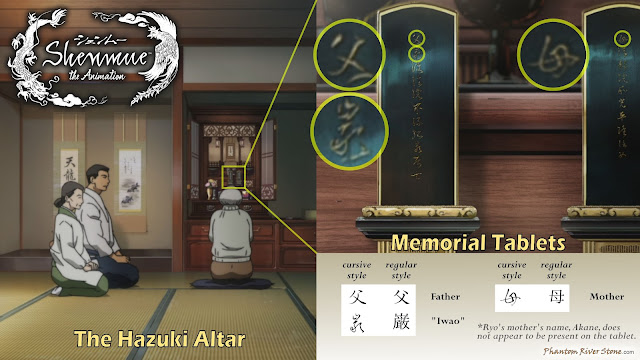
The Hazuki Family Altar contains memorial tablets for Ryo's deceased father, Iwao Hazuki, and his mother.

In a close-up shot, the kanji characters for "father" and "mother" can be seen on the left and right memorial tablets respectively, written in a cursive-style script that has quite a different appearance from standard lettering.

His father's name, Iwao, can also be found written there.

Yamagishi-san visits the family altar (Shenmue The Animation Episode Two).

In the game, the kanji of his mother's name, Akane, is also present but interestingly this does not seem to be the case in the anime's portrayal. It should be noted that the deceased's worldly name is not always written on such tablets.

In a previous post, we wrote about the Hazuki Family Altar and the significance of the various elements. Read about it here.

Become a Patron!

Sunday, January 24, 2021

Xmas and New Year in Shenmue's Yokosuka | Culture


The Shenmue series has been carefully crafted to be played at the player's own pace, without being pressured to rush through to the end. Players are encouraged to take their time and explore and examine the world around them, and are usually rewarded for doing so by the revelation of extra detail, conversations or even cut scenes that might otherwise go missed or unnoticed.

The transformation of the world at New Year in the first game illustrates this perfectly. With the game starting on 29th November, players who progress through the game at reasonable pace may finish the game without seeing the changes in appearance that can be seen around Yokosuka in the game at the start of the year.

Since we are talking about seasonal changes, let's start by noting the changes seen around Dobuita at Christmas as well. These are likely to be encountered by most players of Shenmue.

How Yokosuka Transforms at Christmas


From December 15th to Christmas Day the shopping street in Dobuita enters into the Christmas spirit!
  • Shopping street "piped" music: as Ryo walks along Dobuita Street during this period, a number of Christmassy jingles play. These include renditions of Jingle Bells in the vicinity of the Tomato Convenience store, and Shenhua's Theme outside Uokichi Seafood, played with chimes and pipe organ! Side-note: the game treats this music as part of the sound effects, so it plays in parallel with the FREE exploration music. Also, even today in real-life Dobuita also, Christmas music is piped through speakers during this period, as can be heard in a video taken on location a few years ago.
Become a Patron!

Sunday, February 16, 2020

Ryo's Footwear Habits Revisited | Shenmue 3


One of the many small details in the first game in the Shenmue series is the way that Ryo always makes sure to slip off his shoes when entering his home or the Dojo (with the prologue scene being the one notable and deliberately-made exception), adding a layer of authenticity to the world.
Shenmue I: Ryo removes his footwear when inside the Hazuki residence.
In Shenmue II, however, unlike in the first game Ryo does not remove his footwear at any time, even on occasions where it would have seemingly been natural for him to do so.
One explanation for the absence of footwear removal in Shenmue II may have been due to budget constraints, as it would have required extra cut scenes, modeling and animations. With the release of Shenmue III, we have the opportunity to observe how similar occasions are handled in the latest sequel.

Ryo's Footwear Habits in Shenmue III


We'll look at how two locations that involve situations where Ryo might be expected to remove his shoes, both being in Bailu village with its traditional customs and way of life: Shenhua's house and the house of Elder Yeh.

Become a Patron!

Sunday, July 7, 2019

Illustration for Tanabata, the Star Festival | Shenmue III

Yu Suzuki has tweeted out a Shenmue-themed illustration to mark Japan's Tanabata Festival, with the words: "July 7th. Today is Tanabata."

The Tanabata Festival (七夕, "Evening of the seventh") is a Japanese festival about a legend of the stars in the sky held on July 7th at night. A young married couple, Orihime (the "Weaving Princess") and Hikoboshi (the "Boy Star") angered Orihime's father who separated from each other by the Milky Way. He allowed them to meet each other only once a year, on the seventh day of the seventh month of the calendar. Legend also holds that if the day is rainy, they are unable to meet and will be forced to wait another year.

In the illustration we see Ryo as Hikoboshi and Shenhua as Orihime, with the Milky Way stretching out behind them.

The plant in the illustration is a shoot of bamboo with colorful paper pieces attached to it. In present-day Japan, people generally celebrate this day by writing wishes on small pieces of paper, and hanging them on bamboo, sometimes with other decorations. The bamboo and decorations are often set afloat on a river or burned after the festival.

Something that ties this legend into Shenmue is that Orihime's father is named Tentei, the Heavenly Emperor; in Taoism, this name can also refer to Polaris, the North Star. In past interviews, Yu Suzuki has revealed Tentei to be the mysterious leader of the Chi You Men. So the Star Festival may be more meaningful in the world of Shenmue than it may first appear...

Link to tweet

Become a Patron!

Monday, May 6, 2019

Children's Day Illustration and Cultural Notes

Yesterday, Yu Suzuki tweeted out a Shenmue-themed illustration in celebration of Children's Day, featuring Ryo and Shenhua (and a little yellow bird).

Children's Day is a day on which families in Japan celebrate the healthy growth and happiness of children. It is also a national holiday and is held on May 5 every year.
Children's Day illustration, tweeted by Yu Suzuki. The vertical writing at the left side reads "Kodomo no hi" (=Children's Day in Japanese), while the horizontal writing reads "Tango no Sekku" (explained later in this post).
In the illustration, Ryo is riding atop a blue-colored carp, recalling the image of a character from Japanese folklore who is often associated with Children's Day: Kintarō, a child with superhuman strength who once fought a giant carp, among his many adventures.
Kintarō, a folk hero from Japanese folklore, is said to have fought a giant carp.
In fact, the carp on which Ryo is riding here is in the shape of a windsock known as a koinobori (carp streamer). These streamers are commonly flown above houses with children for Children's Day and can be of various sizes, from smaller ones under a meter on the balconies of inner-city apartments to large ones of many meters in length that are strung up on poles in more open areas.
Become a Patron!

Saturday, April 20, 2019

An Evening Snack in Niaowu | Shenmue 3

In the first two Shenmue games, there were plenty of restaurants and food stands to be found - and even Tom's hot dog truck - but it wasn't possible for Ryo to eat at any of them.

That will be changing with Shenmue III, where managing Ryo's energy (screenshots suggest it will be called "endurance") will be a core part of the gameplay both during combat and while exploring. Ryo's maximum endurance is represented on-screen by a number of balls, a number that can be increased by training.
While exploring: the green balls around the outside of the mini-map represent Ryo's endurance (from a screenshot at Yu Suzuki's talk at Reboot Develop 2019)
Ryo's HP meter during combat (from Yu Suzuki's presentation at MAGIC 2019)
Ryo's endurance is depleted through physical exercise such as fighting or running. We have learned from recent comments by Yu Suzuki that if Ryo grows too tired, he may become unable to run but he can restore his energy by eating various types of food.
Ryo may find or buy snacks that boost his Endurance, such as this banana (from a screenshot at Yu Suzuki's talk at Reboot Develop 2019)
Become a Patron!

Tuesday, April 16, 2019

Bracelets & Prayer Beads at the Waterfront | Shenmue 3

Bracelets & Prayer Beads at the Waterfront | Shenmue 3
Yu Suzuki shared several new Shenmue III screenshots at the Reboot Develop conference last week, and one of these was the above image of Ryo strolling along the waterfront in Choubu (Niaowu) at night.
This post will talk some more about the first stand, as it has a few extra details of interest.
Become a Patron!

Saturday, November 24, 2018

The Hazuki Family Altar - Part Two | The Realism of Shenmue

The Hazuki Family Altar - Part Two | The Realism of Shenmue

Today's topic was selected as the Patrons' Choice topic for November by the Phantom River Stone blog patrons via our monthly poll. If you'd like to have a say in what subjects we cover next, check out our Patreon page here!

In this second part we wrap up our examination of the Hazuki Family Altar, this time investigating each of the individual items that decorate the altar and lie in the drawers. To start from Part One, click here.

The Family Altar in Shenmue


The Hazuki altar in Shenmue has been created with amazing detail, accurately reflecting many of the typical religious items to be found. Here are some brief notes on a few of these.


Become a Patron!

Saturday, November 17, 2018

The Hazuki Family Altar - Part One | The Realism of Shenmue

The Hazuki Family Altar - Part One | The Realism of Shenmue

Today's topic was selected as the Patrons' Choice topic for November by the Phantom River Stone blog patrons via our monthly poll. If you'd like to have a say in what subjects we cover next, check out our Patreon page here!

Shenmue I naturally weaves many facets of Japanese culture into the game, such as the way Ryo takes off his shoes indoors, or the different types of period telephones that Ryo can use around the area.

Today we'll look at another example of Shenmue I's faithful recreation of Japanese culture within the game: the Buddhist altar that can be seen in the Hazuki Residence.

The importance of the altar to the Hazukis can be appreciated by the fact that there is a whole room dedicated to it. And during the game it is not just there for show; as Ryo we able to interact with it ourselves, and furthermore other characters in the story also interact with it as we will cover later in this post.

Become a Patron!

Wednesday, October 31, 2018

Dobuita Street on Japanese TV Show "YojiGoji Days"

Yokosuka was featured yesterday in TV Tokyo's YojiGoji Days, a daily show with information about daily life in Japan. The on-the-scene reporter was retired boxer and celebrity Yoko Gushiken, who visited some familiar locations in the Dobuita Street vicinity.

Gushiken called into a Yokosuka jacket ("Sukajan") shop called First Shokai, whose owner has been hand-making jackets here for around 40 years.

First Shokai: "Sukajan" on display
Gushiken asked to see an actual jacket being worked on...

"I'd like to see one being stitched".
Become a Patron!

Saturday, October 6, 2018

Poll Result: Patrons' Choice Topic for October

Every month Phantom River Stone holds a poll among our patrons to choose a topic for the blog in the coming month. The results are in for October, and the most highly-voted topic (including accumulated votes from previous months) was...

"The altar at the Hazuki Residence." During the game, Ryo vows before this altar to find his father's killer. We'll look at how such altars are a part of day-to-day life for many Japanese households.


We'll be releasing it on the blog later this month.

If you're interested in reading it early, check us out on Patreon - the $2 tier will get you early access as soon as its ready, plus access to all early-access posts for the month. Or participate in voting for a monthly blog topic at one of the higher tiers.
Become a Patron!

Wednesday, May 9, 2018

Trailer: Learn Japanese through Shenmue

Trailer: Learn Japanese through Shenmue

We have put together a trailer for our new series of Shenmue-themed Japanese lessons, to give a little taste of what to expect.

If you've been interested in learning Japanese, this could be the perfect opportunity to get started while enjoying snippets of conversations and scenes from the Shenmue story.


Lesson #1 Available Now for Patrons


The first lesson will be released here on the blog later this month.

If you can't wait to get started, and would like to support Phantom River Stone at the same time, why not become a patron and get early access right now. You'll also get other patron-exclusive content and rewards!


Become a Patron!

Wednesday, May 2, 2018

Mystery Posters on Dobuita Street | Shenmue I

Mystery Posters on Dobuita Street

In Shenmue 1, opposite the You Arcade on a side-wall running alongside the Maeda Barbershop on Dobuita Street, are a couple of slightly strange-looking posters. Have you ever wondered what they are about?

The location of the posters
The location of the posters on Dobuita Street
Examining the posters, each has a large written heading under which is a black-and-white image of a lady and a small child, and it looks as though a coloring effect has been applied to make it look like a film negative:

Two mysterious-looking posters
The two mysterious-looking posters
At the bottom is some indistinguishable text and a small map with a location indicated by a red dot.

So what exactly is the poster about?

Become a Patron!

Tuesday, April 3, 2018

New Series: Learning Japanese through Shenmue

Last month our White Tiger patrons voted in our monthly poll to decide one of the post topics for this month, and the results are in!

The highest-voted topic was "Learning Japanese through Shenmue", which I plan to make the start of a new monthly series aimed at teaching basic conversational Japanese, with a Shenmue theme.

The level will be suitable for new learners, but with a few more advanced items thrown in here and there for people who may already know a little. Japanese voice-acted clips of various characters through-out Shenmue I & II will be used to illustrate words and phrases that are useful for everyday life in Japan (as well as one or two that may be of more interest to those intent on avenging their father's murder).


If you have any thoughts or suggestions regarding the lesson content, comments are welcome.
Become a Patron!