Showing posts with label Kenji Miyawaki. Show all posts

Wednesday, October 8, 2025

Anecdotes & Insights - The Spirit of Shenmue Lives On | Famitsu Dec 2024 [Part 6]

In this post, we present the final part of our English translation of Famitsu’s 25th anniversary roundtable with the original Shenmue developers. In Part 5, the team recounted the challenges of building Shenmue II, reflected on the long road until Shenmue III, and shared their hopes for seeing the series reach its conclusion one day.

In this final part, the discussion closes with a message from actor Masaya Matsukaze, the voice of Ryo Hazuki in the Japanese version, who shares his memories of the series’ early days and what Shenmue has meant to him. The developers then reflect on their own experiences and the lasting impact Shenmue has had on their lives, careers, and friendships.


What Does Shenmue Mean to Each of You?


—As we begin to wrap things up, we’ve received a comment from Masaya Matsukaze, who plays Ryo Hazuki. Let us share it with you now.

Masaya Matsukaze – 25th Anniversary Comment


"I have so many memories tied to Shenmue that I don’t even know where to start...

First off, let me talk about the audition. It was all extremely top-secret, and a ton of people participated. One thing that really stuck with me was being told, “Bring a personal seal (inkan) to stamp the confidentiality agreement - if you don’t have it, you’ll be sent home.” I remember thinking that was pretty strange, and also telling myself, “If I forget it, I won’t just fail the audition, I won’t even be allowed to apply, which would be ridiculous,” so I made extra sure not to forget it.

By some miracle, I passed the audition. I later heard the reason I got the role was, “We knew the production would be tough, so we chose someone who looked sturdy and had a good personality.”

A few years later, the game was finally announced with a press event at Pacifico Yokohama! After years of keeping everything confidential and working in a secret facility, without even telling my own parents, Shenmue was finally going public. But during preparations for my own appearance on stage, we ran into a problem during the costume check. Apparently, it was felt that “Matsukaze’s outfit is lame.” So at the last minute, on the night before the event, I had to run to a department store in Tokyo and buy a whole new outfit! There wasn’t time for tailoring, so the fit was a little off - that’s another memory that sticks with me.

Once, in the dressing room for the motion capture, the actor Yukijiro Hotaru said to me, “You’re still young, right Matsukaze? While you’re young, you should try everything. Later on, you’ll naturally start to weed out the things you don’t want to do, and that’s how you’ll find the path you should take.” I’ve lived by those words ever since. The advice I've received from Yu Suzuki and Hiroshi Fujioka is also something I treasure. The people I met through Shenmue have had a profound impact on who I am today.

Cancellation, then revival - when I was told “The series will be put on hold after II,” I was so shocked it felt like my heart stopped. We had already recorded so much motion capture for what came next... Then, years later, when I heard the words, “We’re making a sequel!” I was absolutely speechless. And then came the anime... Shenmue is full of surprises. You truly never know what’ll happen next. I could go on and on forever.

Oh, and speaking of which - I recently made Ryo’s leather jacket as a hobby project!"

See the full video on Matsukaze's YouTube channel

Become a Patron!

Monday, October 6, 2025

Anecdotes & Insights - From Shenmue II to Shenmue IV | Famitsu Dec 2024 [Part 5]

In this post, we continue our English translation of Famitsu’s 25th anniversary roundtable with the original Shenmue developers. In Part 4, the team reflected on Shenmue’s enduring legacy and casually revealed that a fully playable PlayStation 2 version of Chapter One once existed but was never released.

Part 5 turns to the creation of Shenmue II, an ambitious sequel built on a rewritten engine and systems to support its larger scale. The developers also share stories from the Shenmue III era and reflect on the possibility of Shenmue IV, discussing their hopes for seeing the story completed one day.


Development of the Even More Expansive Shenmue II


—So far we've mostly been talking about Shenmue I, but were there any specific hardships during the development of Shenmue II?

Hirai: I was responsible for all the system programming in Shenmue II, but as for the other parts of the game, that was almost entirely handled by Mr. Wada.

Wada: The first game was set in a small Japanese town. You didn’t need too many people on screen, the streets were narrow and had lots of corners, so you didn’t have to draw things too far into the distance. But Shenmue II was set in a massive city, Hong Kong, so we had to show more people on-screen, and draw much further into the distance to make the city feel alive and expansive.

When we looked at that, it became obvious: there was absolutely no way to achieve that using the system from Shenmue I. I talked with Hirai and the tech team, and we ultimately decided we had to rebuild everything from scratch.

Hirai: The scripting system, the engine, even the C-language parser - we basically changed all of it. At the time, I was also involved with Space Channel 5 Part 2, so if issues cropped up, I would temporarily shift my focus back to Shenmue II to help out.

Become a Patron!

Saturday, October 4, 2025

Anecdotes & Insights - Shenmue’s Legacy and the Unreleased PS2 Port | Famitsu Dec 2024 [Part 4]

In this post, we continue our English translation of Famitsu’s 25th anniversary roundtable with the original Shenmue developers. In Part 3, the group discussed Hirai’s “Shenmue Maker” system, the unique team culture under Yu Suzuki, and the creative energy that fueled the project’s breakthroughs.

Part 4 explores Shenmue’s lasting impact on the developers’ lives and the wider industry - and, casually dropped into the conversation, comes the revelation that a fully functional PlayStation 2 port was developed but never released!


Shenmue's Pivotal Role in the Developers' Lives

Okayasu: I think Shenmue really changed the lives of a lot of the people who worked on it.

A lot of staff came and went during its development. How did all of you feel about that constant turnover?

Okayasu: It was honestly just a "throw more people at it" kind of strategy - pure manpower tactics. And that meant some of the new staff were competent, but others were completely useless.

Kasahara: We had people coming in as "programmers" who had never even written a line of code. It was total chaos. There were even people whose only job was to go out and recruit others. Their performance was judged by how many people they brought in - once they delivered someone, their job was done.

Ahhh... so the whole staffing and operational system was unstructured, and individual tasks didn’t necessarily add up to meaningful progress overall.

Matsuda: Which made things a nightmare for those of us actually on the ground.

Okayasu: Matsuda, what did you think when you got caught up in what we called the "Shenmue Hunt" and you were told to join the Shenmue team?

Matsuda: Oh, I didn’t even get a say in whether I joined the team or not. It wasn’t optional. I still clearly remember that it was right before my very first summer vacation as a new graduate.

Before joining the Shenmue team, I was thinking, “Wow, AM2 really works hard. Pretty intense,” but I figured I’d take a nice break over summer and refresh myself. Then, right before the break, my manager called me in and said (doing an impression), “Matsuda… there’s this game called Shenmue. We’re short on people. The time has come for your talents to be of use. You want to grow as a designer, don’t you?”

And the moment I said, “Yes!” my summer vacation disappeared.

Everyone: (laughs)

Kasahara: That voice impression was actually kind of close. (laughs)

Become a Patron!

Friday, October 3, 2025

Anecdotes & Insights - "Shenmue Maker" & Yokosuka's One-Year Build | Famitsu Dec 2024 [Part 3]

In this post, we continue our English translation of Famitsu’s 25th anniversary roundtable with the original Shenmue developers. In Part 2, the team shared tales of late nights and endless debugging, reflecting the uncompromising standards that defined the project.

Part 3 highlights Takeshi Hirai’s ingenious “Shenmue Maker” system that kept all 88 programmers in sync, and dives into anecdotes about working under Yu Suzuki, including the Zushi Marina retreats where late-night debates (and drinks) helped shape Shenmue’s vision. We also hear a special anniversary message from Yu Suzuki himself.


Hirai's "Shenmue Maker" Programming Concept

— Were there any other parts of the programming that were especially difficult?

Hirai: The "games within a game" at the You Arcade were pretty tough. You can play Space Harrier, Hang-On, and so on inside the game. But to do that, we had to temporarily set aside the data from the main game, load and run the arcade game, and then after playing, return to the main game - and deal with the fact that various internal data would come back completely scrambled. Getting everything to cleanly return to the way it was, as if nothing had happened, and seamlessly resume the main story... that was actually a pretty complex process.

— I see.

Kurooka: Here’s a funny one - you know the capsule toy machines, right? Well, one of the items you can get is Sonic. But Sonic was the only one modeled with an unusually high polygon count, and during development, there was this bug where the game would crash whenever you got Sonic.

Become a Patron!

Thursday, October 2, 2025

Anecdotes & Insights - Shenmue Devs on Crunch & Debugging | Famitsu Dec 2024 [Part 2]

In this post, we continue our English translation of Famitsu’s 25th anniversary roundtable with the original Shenmue developers. In Part 1, the team recalled the brutal work culture, the “general election” that decided the lead programmer, and how some staff turned themselves into NPCs.

Part 2 turns to the harsh realities of debugging, with stories of cardboard naps, 24-hour shifts, bizarre bugs, and the obsessive attention to detail that made Shenmue both a nightmare to create and a one-of-a-kind masterpiece.

The Harshness of the Development Environment

Hirai: You really shouldn’t be starting meetings at 10 p.m., right? We did have a nap room, though. That said, my previous company wasn’t very different, so I thought, “Ah, it’s the same here too.” That was just the era we were in. Still, during Shenmue’s development, I felt way more pressure. I remember seeing my timecard showing "XX" hours for a single month.

Note from Switch: The original article did not provide the exact figures; “XX”/“YY” are placeholders for the actual numbers.

Kasahara: If we’re talking about work hours, then it has to be Wada. Like we mentioned earlier, when you looked at his timecard, he’d barely gone home all month. And he wasn’t the kind of guy to fudge the numbers or cheat the system either. His recorded hours for one month were something like "YY" hours.

— (We could only laugh.) I mean, there are only about 720 hours in a month, assuming 24 hours times 30 days.

Hirai: Wada was known as the ‘mainstay’ of the team. He was always present in the office - that’s how dedicated he was. And he wasn’t even a full-time employee! (laughs)

Kasahara: No matter when you showed up, he was always there.

— Mr. Wada, why were you working that much...?

Wada: I was a contract employee, and I originally worked at another company doing various types of development, but I was brought onto Shenmue under contract. And the content of that contract was to “see Shenmue through to release.” So I felt that unless the game shipped, I hadn’t fulfilled my responsibility. I was just doing what I believed was required of me.

To put it simply, I just didn’t go home for two months. (laughs)

Especially toward the end of development, we had about two solid months of debugging, and the team had to operate 24 hours a day. There were times during debugging when the game would crash, and the testers would be stuck, unable to do anything, until morning. That happened several times, but with no programmers around at those hours, the bugs couldn’t be fixed.

Once someone said, “We can’t do any debugging because there’s no programmer here,” I realized I had to be available around the clock. After that, I basically worked 24 hours a day.

Ryo catches some sleep... unlike some of the developers [Image added by Switch]

Become a Patron!

Wednesday, October 1, 2025

Anecdotes & Insights - Shenmue Devs Celebrate 25 Years | Famitsu Dec 2024 [Part 1]

To celebrate the 25th anniversary of Shenmue's release on the Dreamcast in Japan, Famitsu.com invited several former project members to reminisce over dinner about their experience working to create the masterpiece that is Shenmue and reflect on the game's legacy.

Left to right: Takeshi Hirai, Eigo Kasahara, Makoto Wada, Keiji Okayasu, Kenji Miyawaki, Takashi Matsuda, Toshiyuki Kurooka

The participants were key members from the original Shenmue development team:

  • Eigo Kasahara, who served as Planning Director for Shenmue I and II, and also worked on the Shenmue Passport and the PS4 remaster.
  • Makoto Wada, a programmer on Shenmue I and lead programmer on II.
  • Takeshi Hirai, the main system programmer on Shenmue I.
  • Keiji Okayasu, the Assistant Director on Shenmue I, II, and III.
  • Toshiyuki Kurooka, a programmer on Shenmue I, who focused on events around the Hazuki residence and the basement. 
  • Takashi Matsuda, a CG designer on Shenmue I and II who created many of the game's NPCs. 
  • Kenji Miyawaki, a graphic designer responsible for character designs and UI across the series.
The discussion is full of fun stories and inside jokes, while at the same time revealing just how intense the work environment was at the time, and the immense dedication shown by the development team to bringing the games to life. Not to mention the startling revelation that a PS2 port of Shenmue I was developed internally but never released...

"I didn't go home for two months." - One of the dinner participants.

"This isn't that kind of game!" - Yu Suzuki, upon discovering that the developers had implemented boob jiggle physics.

"We created Yokosuka from scratch in just one year - after the game's announcement (at the Shenmue Premiere)" - Takeshi Hirai.

The article translation starts below.

Become a Patron!

Wednesday, July 9, 2025

Poll Result: Patrons' Choice Topic for July 2025

Every month Phantom River Stone holds a poll among our patrons to choose a topic for the blog in the coming month. After tallying the votes (including accumulated votes from previous months), the winning topic that has been voted this time is:

Famitsu.com article: 25th Anniversary Shenmue Reunion with Key Former Developers

To celebrate the 25th anniversary of Shenmue's release on the Dreamcast in Japan, Famitsu.com invited several former project members to reminisce over dinner about their experience of working to create the masterpiece that is Shenmue and reflect on the game's legacy.

Left to right: Takeshi Hirai, Eigo Kasahara, Makoto Wada, Keiji Okayasu, Kenji Miyawaki, Takashi Matsuda, Toshiyuki Kurooka

The participants consisted of key members from the original Shenmue development team:

  • Eigo Kasahara, who served as Planning Director for Shenmue I and II, and also worked on the Shenmue Passport and the PS4 remaster.
  • Makoto Wada, a programmer on Shenmue I and lead programmer on II.
  • Takeshi Hirai, the main system programmer on Shenmue I.
  • Keiji Okayasu, the Assistant Director on Shenmue I, II, and III.
  • Toshiyuki Kurooka, a programmer on Shenmue I, who focused on events around the Hazuki residence & the basement. 
  • Takashi Matsuda, a CG designer on Shenmue I and II who created many of the game's NPCs. 
  • Kenji Miyawaki, a graphic designer responsible for character designs and UI across the series.
The discussion is full of fun stories and inside jokes, while at the same time revealing just how intense the work environment was at the time, and the immense dedication shown by the development team to bringing the games to life. Not to mention the startling revelation that a PS2 port of Shenmue I was developed internally but never released...

"I didn't go home for two months." - one of the dinner participants.

"This isn't that kind of game!" - Yu Suzuki, upon discovering that the developers had implemented boob jiggle physics.

"We created Yokosuka from scratch in just one year - after the game's announcement (at the Shenmue Premiere)" - Takeshi Hirai.

Coming soon to the blog!

Become a Patron!

Saturday, May 31, 2025

The Project Berkley Bonus Disc | Dengeki Dreamcast Magazine (January 2000)

A mysterious scene from the CG movie on the Project Berkley bonus disc

Japan's Dengeki Dreamcast magazine contained a huge 50-page Shenmue feature in its January 28 edition. Within this feature was a reflection on the intriguing Project Berkley bonus disc that had been released a year prior and even today can be considered to hold an abundance of hints and glimpses as to how Shenmue's plot might once have been (and even could still be) going to unfold.

Magazine page images kindly provided by SkillJim.

Why "Project Berkley"?

In the late 1990s, SEGA's AM2 division, led by Yu Suzuki, embarked on an ambitious venture known internally as Project Guppy. Initially conceived with the title of Virtua Fighter RPG for the SEGA Saturn, the project subsequently transitioned to the SEGA Dreamcast and was renamed Shenmue and the associated code name changed to Project Berkley. Code names were used to maintain confidentiality during development, adding an aura of mystery to the undertaking.

At his GDC 2014 post-mortem talk, Yu Suzuki reveals how the code name changed during development together with the game's title.

In recent years, Yu Suzuki has revealed the inspiration for the name "Project Berkley":

Q: At the beginning the game was given the codename “Project Berkley”, is there any special meaning behind this name?

YS: It’s actually like this [laughs]: because we realized at the start that this would be a completely different game to anything else on the market at the time, and its scale was unprecedented, we wanted to keep the project very confidential. Because of this we wanted to give it a very cool sounding name, like something from a spy movie. In Japan there’s this phrase bakkureru (ばっくれる) meaning to “pretend not to know” or “feign ignorance”, and by coincidence that there is a place in America with a similar sounding name, so we chose this “Project Berkley” codename.

A special feature of approximately 30 minutes, with the same name of Project Berkley, was included with the Japanese version of Virtua Fighter 3tb, released on Dreamcast in November 1998. Containing a CGI trailer, an extended interview with Yu Suzuki and various concept art, it provided gamers with an early glimpse into the project's innovative vision, highlighting its potential to revolutionize gaming.

The Virtua Fighter 3tb release included a bonus disc
Become a Patron!

Monday, January 15, 2024

Muecas Dan: Sega's Official Shenmue Fan Club

Muecas Dan logo and slogan ("We are the Muecas Club!! ~We Deeply Love Shenmue~")

What Was "Muecas Dan"?


"Muecas Dan" (ムーキャス団) was a Shenmue fan club that regularly published Japanese-language Shenmue content online. It ran from early 2001 to 2004, and its founding members consisted of staff from the official Shenmue project team.

Shenmue Cast FAN


Muecas Dan was formed by the official Shenmue team to communicate with fans. Fans who made contributions to their web magazine were recognized as Muecas Dan members.

Muecas Dan was introduced in the January 2001 (Vol. 60) edition of the Weekly AM2 online magazine, in a section initially called 'Shenmue Cast Fan' - here 'cast' referred to members from the Shenmue project team.

"Yes! We are Shenmue's Cast Fans!" - the logo for the Shenmue Cast FAN page


Become a Patron!

Wednesday, December 21, 2022

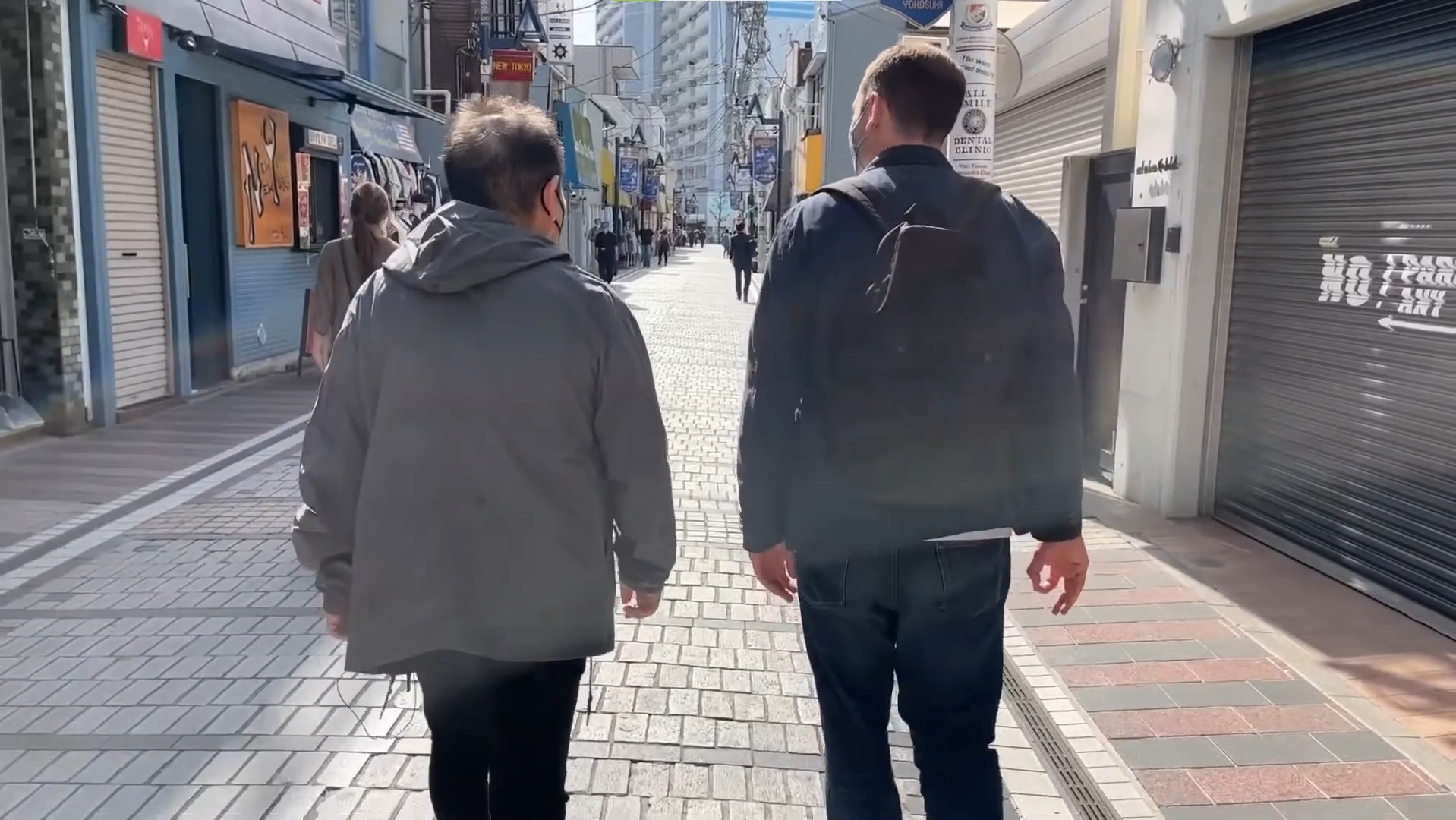
Yu Suzuki's Visit to Dobuita Street with IGN Japan | Video with ENG Subtitles

As part of the Shenmue the Animation promotional celebrations earlier this year, IGN Japan's Esra Krabbe met up with Yu Suzuki in the real Dobuita, in Ryo's hometown of Yokosuka (April 2022). As the original video was made available with Japanese audio only, for this post we have added English subtitles so fans around the world can enjoy hearing the series' founder reminisce about the development of the games and the anime series.

This is the extended version with extra footage compared to the originally-released video. I hope you enjoy hearing Esra and Yu-san's comments as they soak up the atmosphere and interact with various shopkeepers.

In a future post we plan to cover the concept and storyboard art shown in this video, which was displayed in several shops around Dobuita as part of the event, in detail.

A transcript with still images from the video follows after.

This topic was selected by the Phantom River Stone blog patrons via our monthly poll on the Phantom River Stone Patreon and was available for early access. Thank you for your support!

Video


Transcript


<Esra Krabbe & Yu Suzuki greet each other outside the Honey Bee restaurant in Yokosuka>

Krabbe: Hello, Yu-san! Long time no see.

So, this is the the "Honey Bee". In the game the name is Funny Bear. This is the place, isn't it. It was the inspiration, so how about we grab a bite?


Become a Patron!

Friday, November 13, 2020

New Kenji Miywaki Art | Shenmue III Soundtrack Digital Pre-Orders Open

Brave Wave has announced that pre-orders are now open for the Digital Edition of the Shenmue III Soundtrack.

Head over to the Bandcamp page for "Shenmue III - The Definitive Soundtrack" to listen to 5 of the tracks which are available for free preview:

  • Shenmue Theme - Piano
  • Hide & Seek
  • Main Theme Kokyu (Erhu) Solo
  • Boundless Lands
  • Happy Convenience (The Tomato Mart Theme!)

Along with this announcement, a custom piece of art by character designer Kenji Miyawaki was also revealed. On Twitter, Brave Wave said:

"For our upcoming Shenmue III OST, we teamed up with original Shenmue artist Kenji Miyawaki to create a brand new illustration exclusively available with the complete OST".

It looks amazing! 


See our earlier post for information on the release schedule of the various editions:

Become a Patron!

Thursday, August 13, 2020

Project Team Memories of Working on Shenmue | Famitsu Article Translation

Project Team Memories of Working on Shenmue

This is a translation of an article published online by Famitsu.com in November 2018 to commemorate the release of Shenmue I & II. Comments about working on the original Shenmue project were gathered from:
  • Masaya Matsukaze (Ryo Hazuki)
  • Takahiro Sakurai (Lan Di, Goro, Yuan)
  • Megumi Yasu (Nozomi)
  • Ikue Otani (Fangmei)
  • Rio Natsuki (Joy)
  • Tow Ubukata
  • Toshihiro Nagoshi
  • Takenobu Mitsuyoshi
  • Yasuhiro Takagi
  • Kenji Miyawaki
The translation begins below.

In commemoration of the release of Shenmue I & II for the PS4 on 22nd November 2018, we gathered comments from some of the staff members and performers who were involved with the creation of the original games. Enjoy hearing them speak about their remembrances and hardships of the time. (See our separate article to read comments from Fujioka Hiroshi).

Masaya Matsukaze


Role: Ryo Hazuki

Masaya Matsukaze

"Ryo Hazuki is my other self"
Back when amusement arcades were booming, arcade game hit-maker Yu Suzuki turned his talent to creating a home console game. There was a large-scale audition that attracted actors in the motion picture industry, and as I was a Mega Ranger at the time that is when I first met Yu-san.

The game started as "Virtua Fighter RPG", and its genre was the world's first of its kind, designated as "FREE" (an acronym for Full Reactive Eyes Entertainment") but these days called open-world. What Yu-san ideally wanted was "freedom in everything, where things you would expect to happen would naturally happen," and together with a staff of hundreds, he took on the challenge of creating a world that had never before been seen.

I was in charge of the motion capture and spoken lines for the protagonist, Ryo Hazuki. The actions ranged from basic movement like sitting and walking, through to those for QTE events where Ryo would punch or alternatively get punched. When he falls from a high place, that is me falling. Falling down from a height of 15 meters (!) would be fatal, so for this motion capture data for falling from a low height would be extended, along with motion capture for hanging in mid-air and dropping down, The spoken lines for striking up conversations with people had slight variations each time, so I recorded all the lines needed for talking to the same person multiple times, even if they would probably never be heard by the player. It was really a huge volume of recording.

Some of Yu Suzuki's works are on display in the Smithsonian Museum, and this legendary work set a new record in gaming history. Furthermore, this long journey continues on with Shenmue III. There is rarely such an opportunity to obtain a truly legendary work yourself at such an affordable price. I encourage everyone to pick up a copy!

Become a Patron!