Friday, October 8, 2021

Poll Result: Patrons' Choice Topic for October 2021

Every month Phantom River Stone holds a poll among our patrons to choose a topic for the blog in the coming month. After tallying the votes (including accumulated votes from previous months), the winning topic for October 2021 is...

"Unused Inventory Items Found in Shenmue disc files"

All Shenmue players will be familiar with the inventory screen and its depiction of small icons that represent the things Ryo is carrying at the moment.
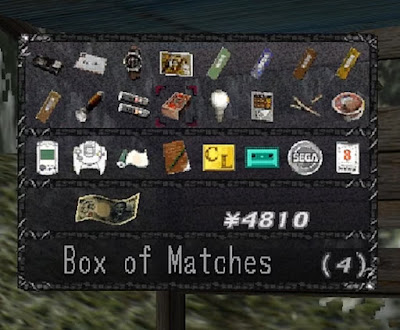
Ryo's inventory display (Dreamcast)

As to be expected, the inventory icon graphics themselves are contained within the Shenmue files. A similar, but different, set is also present on the What's Shenmue demo version of the game that was distributed in Japan a few months ahead of the full release.

Where things get interesting is when the What's Shenmue icons are examined more closely. We'll be sharing discoveries made by LemonHaze of the Dragon & Phoenix project, who found a small number of object icons on the earlier What's Shenmue disc that are not used in either game. A few are readily recognizable as objects Ryo interacts with (but does not keep) during the main game, while a couple are harder to identify.

We'll be examining these unused icons in this upcoming post, and with input from readers perhaps they can all be identified.

Watch for it on the blog in the near future.

Become a Patron!

Wednesday, October 6, 2021

Mini-Interview with Shenmue Composers Yuzo Koshiro & Takenobu Mitsuyoshi | January 2000

A mini interview with Yuzo Koshiro and Takenobu Mitsuyoshi, two composers on the Shenmue project who were already known as legends in the gaming world at the time. This interview was translated from the January 2000 issue of the Japanese Dreamcast Magazine, published soon after the initial release of Shenmue in Japan.

The translation starts below.

Yuzo Koshiro and Takenobu Mitsuyoshi

Usually, only one or two people are in charge of the sound for a single game. However, Shenmue has more than 30 music team members involved. Some of you may have noticed the name of a legendary sound creator among them. Yuzo Koshiro. This legendary man has enchanted fans with the numerous famous songs he has composed for classic games of the past. Let's take a closer look at the secrets of the Koshiro sound that inhabits Shenmue!

About Yuzo Koshiro

Yuzo Koshiro is 32 years old. In the past, during Nihon Falcom*'s heyday, he developed sounds that made full use of FM sound generation for games such as Ys, Sorcerian, Dragon Slayer V, and Xanadu, and quickly gained a strong reputation among fans. His relationship with Sega began during the Mega Drive era when he established a sound that thrilled fans with The Super Shinobi and Bare Knuckle.** Ten years ago, that "Koshiro sound" was his trademark. Recently, after Vatlva and Culdcept, he has been stepping away from the sound business to focus on his work as senior managing director of Ancient Corp.

*[Switch] A Japanese video game developer of role-playing video games, most notably the Ys, The Legend of Heroes, and Trails series. The company was founded in 1981.
** Known as The Revenge of Shinobi and Streets of Rage respectively, outside Japan. 
Become a Patron!

Saturday, September 25, 2021

Weekly AM2 Vol. 4: Shenmue New Year's Card Giveaway | 4th Jan 2000

In this series we translate Shenmue content from Weekly AM2, the official online magazine published by Sega's AM2 development team back in the day. News and information about the Shenmue series could be found regularly within these pages from the end of 1999 through to 2001 with the release of Shenmue II.

Vol. 4 was a fairly brief update posted at the start of the new millennium, shortly after the official release of Shenmue in Japan on December 28th. While not much news is contained, we do learn the nickname of Megumi Yasu, the actress playing Nozomi (read on to find out!). A lucky draw is announced for Shenmue-themed New Year Cards - of which only two were available. Let's hope they were kept and treasured by the winners.

-Switch


Vol.4: 2000.1.4

Happy New Year to you all.

This is Takuan.

I hope you're all well and enjoying Shenmue.

Let's have another great year!

This week's contents:
  • New Year's Greetings from the Shenmue actors
  • Outtrigger Event [omitted from translation]
  • Shenmue New Year Card Present

Become a Patron!

Sunday, September 19, 2021

Shenmue Tree? Cherry Tree? | Shenmue 3 Translations

Something that has led to a lot of discussion among fans is the nature of the tree that stands gracefully in full bloom at Ternary Spring, outside the house of Grandmaster Feng in Shenmue III. When Ryo visits the area, the tree is mentioned in conversation with both Shenhua and Grandmaster Feng, but nothing is said that would remove doubt about its identity - is it supposed to be an actual Shenmue tree?

The tree at Ternary Spring

This question is not as easily answered as it may at first appear, since the tree is treated inconsistently between Shenmue II and III, as well as between the Japanese and English language versions.

In this post we'll attempt to bring together the known evidence to help judge the tree's true nature.

The Shenmue Dojo forums served as a useful reference for this post, with various theories and discussions made on this topic.

Shenmue Tree Hypothesis


An obvious place to start is by examining the tree's appearance, in particular the pattern of its bark and the shape of its flowers, and compare this to the tree at Shenhua's house which we know from Shenmue II to be a Shenmue tree.

Complicating matters, the Shenmue tree in the third game was considerably reimagined. This is how it looked in the second game:
Appearance of the Shenmue tree in Shenmue II (roots, whole form and blossom)

Become a Patron!

Wednesday, September 8, 2021

Poll Result: Patrons' Choice Topic for September 2021

Every month Phantom River Stone holds a poll among our patrons to choose a topic for the blog in the coming month. After tallying the votes (including accumulated votes from previous months), the winning topic for September 2021 is...

" Interview with Shenmue sound staff: Yuzo Koshiro, Takenobu Mitsuyoshi (January 2000)"

We will be translating an early magazine interview with two legendary music composers who were part of Shenmue's Sound team: Yuzo Koshiro and Takenobu Mitsuyoshi. Among the numerous games for which Yuzo Koshiro has composed music are the Ys series in the late 1980s and the Streets of Rage series in the 1990s, while Takenobu Mitsuyoshi has been composing for Sega games since the 1990s, including work on the Virtua Fighter series and the theme song for Daytona USA.


This interview was published in a January 2000 edition of the Japanese Dreamcast Magazine, soon after Shenmue's release in Japan.

Watch for it on the blog in the near future.

Become a Patron!

Saturday, September 4, 2021

Weekly AM2 Vol. 3: Shenmue Triathlon | 28th Dec 1999

In this series we translate Shenmue content from Weekly AM2, the official online magazine published by Sega's AM2 development team back in the day. News and information about the Shenmue series could be found regularly within these pages from the end of 1999 through to 2001 with the release of Shenmue II.

Vol. 3 was released on 28th December 1999, one day before the official release of Shenmue in Japan on the 29th, and announces a speed run competition named the Shenmue Triathlon. The Weekly AM2 logo has also been revamped with the tagline "Always bringing you the hottest topics" (complete with three exclamation marks at the end!).

-Switch


Vol.3:1999.12.28

Hello! This is Takuan.

Another year comes to an end, and with it the release of the long-awaited "Shenmue Chapter 1: Yokosuka".

This is the last Weekly AM2 of the year, and I'll be bringing it to you with the utmost enthusiasm!

This week's contents:
  • "Shenmue Chapter 1: Yokosuka" Releases at Last Tomorrow!
  • Shenmue Strategy Guide Releases on January 7th!
  • Announcing the Shenmue Triathlon!
  • Commencing the Shenmue Original Wallpaper Download Service!

Become a Patron!

Tuesday, August 24, 2021

March 2021 Yu Suzuki Interview Part Two | SEGA Hard Historia

Part Two of our translation of a new interview with Yu Suzuki that was published in the recently-released SEGA Hard Historia book, featuring retrospectives with various key developers and staff members over the years.

Part One can be found here if you haven't yet read it:

In the second and final part of the interview, Yu-san talks about the evolution of 3D in games, and the Sega Saturn and Dreamcast eras.

Source material supplied by SkillJim (James Brown). Check out his SEGA Hard Historia unboxing video at the end of the article!

The interview translation continues below, with Yu describing how he gathered video footage for Out Run during his trip in Europe.


YS: We took videos with a camera to the hood and near the wheel suspension, attached with duct tape or string. It also had a sunroof, so I opened the sunroof and filmed from there. When I was thinking over what the player's car should be, I saw a red Ferrari outside a public casino in Monaco. A Testarossa. And it was a convertible. "That's it!", I thought, "There's no car more exciting, no car with more presence, no other car more enviable!" And the sunshine, unlike in Japan, was so crisp and clear. With its vivid red color shining brightly, under a blue sky and white clouds - I knew this was it.

Q: You next went on to create After Burner and G-LOC. What motivated you to create those?

YS: Well, there wasn't anything connecting on to these games. Mr. Hayao Nakayama, who was the (Sega) president at the time, was talking a lot about how MicroProse had released a flight simulator that had become a hit in the US. He was always saying, "Don't we have a flight simulator?" So I thought, "Why don't we make a flying game?"

It was like when I was working on Out Run and Hang On. Namco had games like Pole Position, and there was a general perception that racing games were Namco's thing. So when Mr. Nakayama said, "Don't we have a racing game?" I thought, "I should make one." (laughs) When I started Hong On, I had thought of making a racing game, but cars running into one other didn't seem very appropriate, so I decided to go with Hang On. So that's why there was this sense that Namco was the only company that made racing games. If I was going to make a game, I wanted to make one with something like the F14. Also, part of it was because Space Harrier gave me the chance to try something I hadn't done before. At the time, there was no 3D hardware, you see.

So I rendered 3D airplanes with a 3D library I had built, and made use of the resulting set of images, switching between them. I input all the data for the plane by hand, using 3D software tools I wrote myself. As they were sprites, I was free to hand-draw them how I wanted, but if I made the missiles look too smooth, they wouldn't look 3D. I wanted them to have a polygonal appearance, so I purposely made them hexagonal.

After Burner: Suzuki deliberately gave the missiles a hexagonal look
Become a Patron!

Wednesday, August 18, 2021

Mar 2021 Yu Suzuki Interview: SEGA Hard Historia | Part 1/2

A new interview with Yu Suzuki was published in the recently-released SEGA Hard Historia book, featuring retrospectives with various key developers and staff members over the years. In this first part of the interview, Yu-san talks about his early game development days at Sega. The interview took place in March this year (2021).

Special thanks to James Brown for supplying the source material. James also has a superb unboxing video introducing the complete SEGA Hard Historia package, linked at the end of the article.

The interview translation (Part One) starts below.


AM2's Yu Suzuki gained immense popularity with his series of legendary hits in Sega's arcades, as well as ports such as Virtua Racer, in the Mega Drive's later years, and Virtua Fighter for the Sega Saturn. Sega's legendary creator reveals story upon story from those days...

Anecdotes on arcade hits and what Sega was like at that time

Q: What was Sega like when you joined the company (1983)?

YS: SEGA was originally a foreign company, so at that time, all the documents were in English. Issue sheets and all sorts of other things were all in English. It struck me as a somewhat peculiar company. I was in the development section - at the start I was asked if I wanted to be in Software, Design (which is what art was called) or Sound. I was interested in all three, but my boss, Mr. Yoshii, told me that software was the way to go, so I joined Software. I still remember that the Software and Hardware sections were in the same general area. Later, Sega would be divided into the Hardware section, Software section, Console section, and Amusements section, but at that time, Software and Hardware were huddled together in the same place.

Become a Patron!