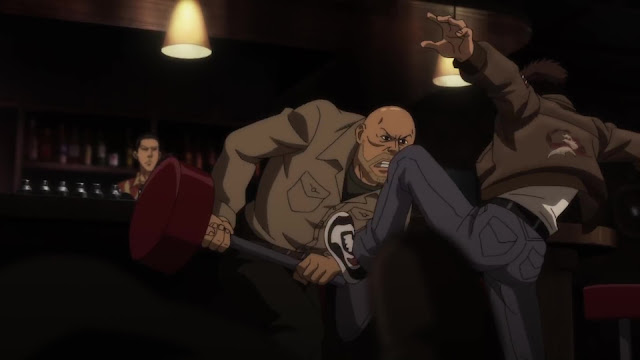
In this post, we translate a short 2022 interview that was held with Masaya Matsukaze, who voiced the protagonist Ryo Hazuki in Japanese in all Shenmue games, about his involvement in the Shenmue the Animation anime adaptation. The interview was conducted during the period of the anime’s broadcast in Japan.
Matsukaze also shares memories from the recording booth and offers insight into why even the smallest details in Shenmue continue to resonate decades later.
The translation begins below.
Originally released in 1999 on SEGA’s home console, the Dreamcast, Shenmue is a legendary action-adventure game that has influenced countless titles since.
Now, the anime adaptation Shenmue the Animation has been streaming across various platforms since April 2022, and as of May, has also begun airing on TOKYO MX [TV station].
We’ve obtained an official interview with Masaya Matsukaze, who plays the lead role of Ryo Hazuki. In it, he talks in depth about the anime adaptation, describing it as proof that “the miracle isn’t over yet.” He shares his impressions from the voice recording sessions, his thoughts after watching the finished episodes, and what continues to make the world of Shenmue, including the original game, so captivating.
We have prepared a quick survey with a couple questions on Shenmue III. Please consider filling it out if you're a fan of Ryo's antics or just familiar with the game. Your feedback will be invaluable to us, as always!"
The survey page itself starts with a brief note acknowledging fans' anticipation for news on their plans:
"Happy birthday, Shenmue!
The 25th anniversary of Shenmue's release in Japan is coming soon, while the 5th anniversary of Shenmue III's release was just celebrated last month. What fantastic milestones for this legendary saga!
We know you’re eagerly awaiting a statement from us, and we deeply appreciate your patience. Our collaboration with YS NET has been very fruitful, but we are carefully reviewing all details. This process takes time, and we thank you for your understanding."
The Survey Questions:
These are the questions for which feedback is being sought:
1. On which platform would you like to see Shenmue III?
Apple Mac
Xbox Series X|S
Nintendo Switch
PlayStation 5
2. What graphics and performance improvements would you like to see for Shenmue III?
3. What's your favourite moment in the whole Shenmue series?
Comment:
It is very encouraging to see another indication of how much the new publisher cares about the franchise, to the extent of reaching out to gather feedback directly from fans. This bodes well for the future of the series.
Regarding the questions themselves, which are focused on Shenmue III as expected, they hint at what the new plans for the game may include.
Publishing ports to other platforms is something that fits in with their promise from their press announcement to ensure its "accessibility to even more fans around the world".
Graphics and performance improvements suggest that they may be planning to work together with YS Net to address issues and better the experience for players. This might include things like increasing draw distance, removal of the "no running" loading areas or even updates to title screens or menus - let them know!
It is also good to see the inclusion of the question about your favorite moment in the whole series, showing that they are gathering feedback about what makes the Shenmue franchise special. Hopefully this will feed into further plans in the future, and may even find their way back to Yu Suzuki himself.
I encourage all Shenmue fans to fill out the survey if you haven't already - it only takes a minute to complete!
Although several days have passed since the announcement caused a flurry of excitement in the Shenmue community, we could not let it go unmentioned on the blog any longer: with the blessing of YS Net, ININ Games has assumed publishing rights for Shenmue III!
The YS Net Press Release
It all started with a rather inconspicuous news entry added on 19 November 2024 to the YS Net official site, simply titled "Notice Regarding Shenmue III Publishing Change". This linked to a press release document that announced the immediate transfer of publishing for Shenmue III to ININ Games, stating:
"Following the previous collaboration on Air Twister, this will deepen the relationship between ININ Games and YS NET. Known for their commitment to celebrating beloved titles, ININ Games is excited to shepherd Shenmue III into its next phase.
This collaboration marks the beginning of a new chapter for Shenmue III, with ININ Games working closely alongside YS NET to honor the series' legacy while ensuring its accessibility to even more fans around the world".
The ININ Games Press Release
A couple of days later, an online article by Gematsu quoted a press release from ININ Games. After noting the significance of the transfer date coinciding with the 25th anniversary of the Shenmue series and the fifth anniversary of Shenmue III, the release continued:
"We at ININ Games are honored to carry the Shenmue torch forward during such a significant moment in the series’ history. As we reflect on two decades of innovation and passion, we remain dedicated to preserving and sharing the journey of Ryo Hazuki with both long-time fans and newcomers".
(Note, there had been some initial confusion about whether the rights were for the complete franchise, but it was later clarified to be just Shenmue III).
The timing, on the 5th anniversary of Shenmue III, suggests that the previous publisher, Deep Silver, had publishing rights for a period of five years from its release. In addition, the mention of ensuring "accessibility to even more fans" suggests that the exclusivity to Sony's PlayStation platform has now also ended.
Earlier this month saw the release of a brand-new, extensive interview with Yu Suzuki that was held in person by James Brown of the Shenmue Dojo and myself (Switch) for Phantom River Stone at the YS NET office in Japan.
The full interview can be found at the Shenmue Dojo's website, who have also recorded an in-depth discussion stream but in this post we will focus in on summarizing some of the most surprising story details revealed during the interview, ending with new information regarding the leaders of the Chi You Men!
The Day of the Interview
On the fine Spring morning of the interview, we gathered at a local coffee shop in the vicinity of the YS Net office for a quick run-through of the topics we would be covering, and making sure reference images were at hand and ready. Having been granted such a precious opportunity to spend time with the legendary game creator, we wanted to be sure not a single minute in his company would go to waste due to lack of preparation.
Today, we will do a deep dive into an iconic communication method seen in Shenmue: the Chawan Sign, which Ryo first learns about in Shenmue II (and is reintroduced later in one of the Shenmue III DLC stories). He makes use of the Chawan Sign to discreetly communicate with allies, by arranging teacups in a certain pattern in a public place,
Arranging four teacups
Ryo is warned that placing them at the wrong location, or carelessly arranging them in the wrong pattern, can result in unwanted attention...
Trying at the wrong location may attract trouble
But was the concept of the Chawan Sign something that Yu Suzuki and team created purely for Shenmue, or did it have some kind of historical basis?
In this post, we will try to answer this question by looking at a possible sources of inspiration.
One notable difference seen from external observation, even before Ryo steps inside, is that Shenhua's house in Shenmue III has a difference in shape compared to Shenmue II.
Originally, the house's footprint was previously a simple "L" shape:
Shenhua's house, Shenmue II
However in the later game, the right-hand side of the house has been extended with a new wing:
We'll examine this image more closely in this post!
Previously in this series, we walked through the entire sequence of events (first half, second half) that would likely have taken place during Ryo's visit to Miao Village, based on the dialogue text files from the Game Jam prototype build of Shenmue II.
This time, we will run through extra dialogue and interactions Ryo can have with various characters. These aren't necessarily part of the main story flow, but they shed more light on the relationships and personalities of the villagers.
Note: in some places in the dialogue files, varied responses from a character can be identified with respect to a single query from Ryo. This may indicate where a different response is picked (perhaps at random) each time Ryo asks the same question.
Miscellaneous Dialogue
Miscellaneous Dialogue: Yiming Ke
Yiming Ke is the elder brother of Rong and son of Cuili. Although his character didn't feature in our previous story summary posts, he is one of the most specific in his directions about how to find certain landmarks, adding to our knowledge of Miao Village's layout.
In this post we complete our examination of the Key Story Beats for the Miao Village arc with the final entries 7 to 10, highlighting conversations found in the recent Game Jam prototype of Shenmue II.
Miao Village Story Arc Recap to This Point, Entries 1-6:
Ryo speaks with Zhang, who claims to be Yuanda Zhu's aide and asks Ryo to retrieve the second volume of the Wulinshu martial arts book from a man named Kongzheng Luo who lives in Miao Village. Ryo volunteers to assist the elderly owner at Sunny Capital Pharmacy by delivering some herbs to Miao Village by bicycle, together with his niece Xiaoqing. After carrying out this task, Ryo then asks passers-by as to Kongzheng's whereabouts and learns that he was killed two weeks earlier.
We now pick up again with Ryo looking for a way to get inside Kongzheng's house, which is locked up, to search for more clues about his death.
Recently, a previously-unseen Shenmue II prototype was successfully purchased at an online auction and, thanks to the generosity of the group behind the purchase, it was shortly afterwards released to the community. This discs were marked "Game Jam," which was the name of an event that occurred in April 2001.
Perhaps one of the biggest questions at the forefront of the minds of many fans was whether the prototype would help reveal anything more on the topic of the legendary Miao Village that had been cut early in development.
And this proved to be the case! Shortly after the prototype's release to the community, the discovery of a wealth of Miao Village related dialogue content on the discs, in the form of Japanese subtitle files for conversations and events, was announced on the Shenmue Dojo forums by veteran Shenmue hacker LanDC (link to thread and discussion) with detailed explanations of several key conversation sections.
It is now possible to piece together a comprehensive picture of the cut story content, and confirm at last what had once been theories and suppositions: how Miao Village was to have been integrated into the main story, details of the bicycle quest with Xiaoqin, and the true meaning of the dialogue seen in the AM2 screenshots all those years ago.
Starting with today's post, we will be presenting as much of the newly-found Game Jam dialogue as possible, and present it in a logical order that reflects the most likely sequence of events relating to the Miao Village content.
Notes:
The conversations shown here have been translated from the Japanese dialogue data extracted from in the Game Jam discs. The original Japanese text is also provided for reference with each conversational interaction.
The original dialogue content that remains on the Game Jam version covers only a subset of all the characters that would have once been part of the Miao Village subplot, however it is still substantial enough to draw useful conclusions.
Some notes have been added in italics, such as to indicate when a character is pointing, or when new information has been learned that gives Ryo a new objective. These are speculations based on the dialogue context.
The Shenmue II order has been followed for the names of Chinese characters e.g. Lishao Tao (rather than Tao Li Shao).
A selection of conversations with various characters has been included, included repeated questioning, to demonstrate the variety of interactions through which Ryo is able to acquire clues.
Miao Village Story Arc: Key Story Beats
Below are the key story beats that can be identified in the cut subplot. They have been assembled into an order that appears to fit the content best.
Cut Scene: Meeting Zhang & a Mission to Retrieve the Second Volume of the Wulinshu
Searching for a Way to Miao Village
Visiting Sunny Capital Pharmacy & a Bicycle Delivery Quest
Medicine Delivery at Miao Village
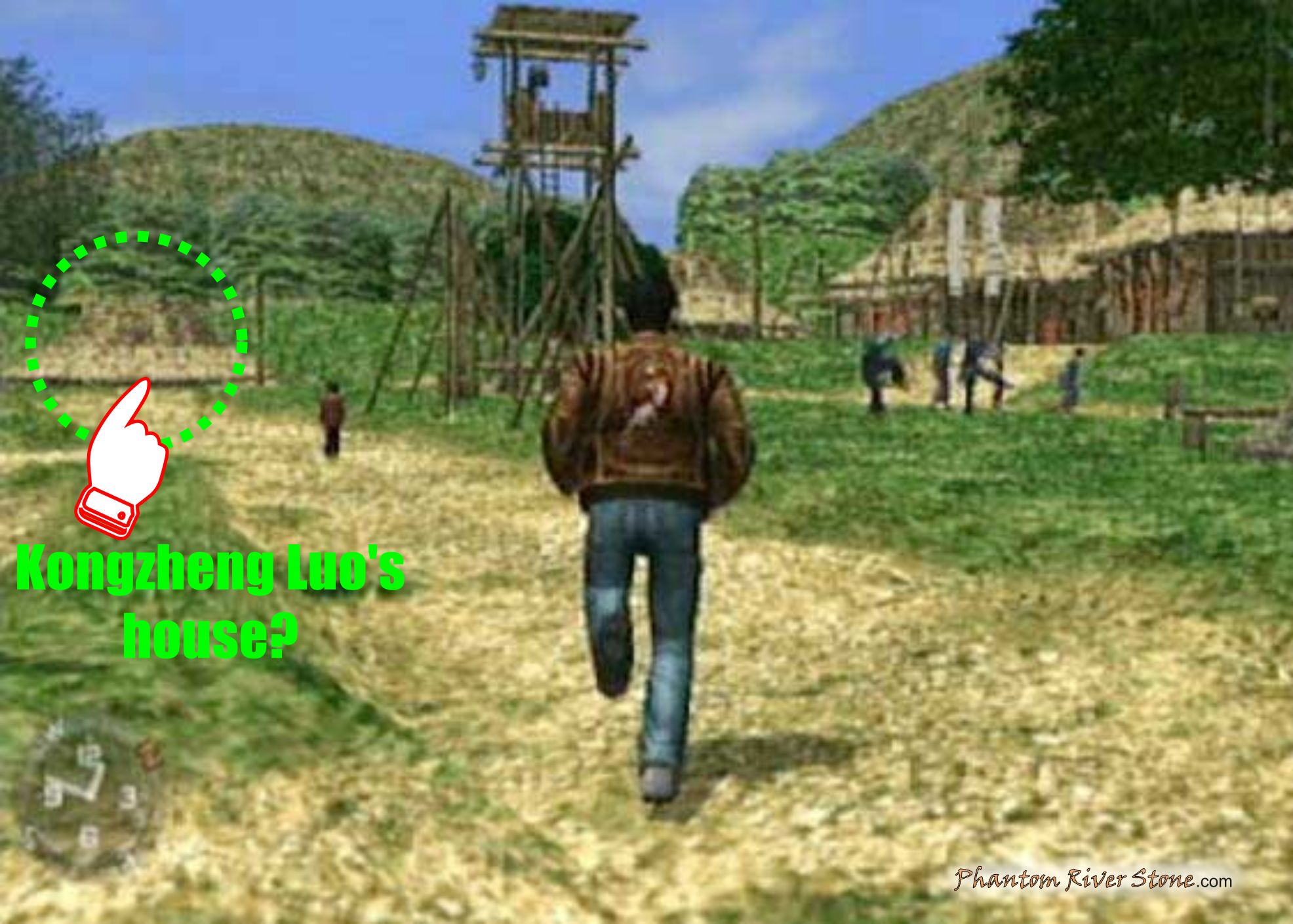
Looking for Kongzheng Luo's House
A. The Fate of Kongzheng Luo B. Master Yunhai's Friendship with Kongzheng Luo
A. Finding a Way to Enter Kongzheng Luo's House B. Obtaining the House Key C. Identifying the Boy in the Photo
Talking with Zhengye Luo
Cut Scene: Visiting Master Yunhai at Miao Guang Temple
Delivering the Wulinshu to Zhang
We'll run through each of these in detail.
Starting Point of the Miao Village Cut Content
The first relevant dialogue is a cut scene, that takes place with Yuanda Zhu's aide, Zhang. At this point in the story, it can be assumed that the following events have occurred as they do in the release version of the game:
Ryo has met Lishao Tao and discovered the Wulinshu in the library at Man Mo Temple. Inside the book he found a note with the Chawan Sign, which serves as his next clue to locating Yuanda Zhu.
After making the Chawan Sign at the Dou Jiang Diner, he has met with a man in a brown suit, who we later find out is named Zhang, who revealed that he serves Yuanda Zhu. However before Ryo had a chance to ask him any questions, several thugs burst into the restaurant and abducted Zhang.
A QTE event played out in which Ryo chases after the thugs - dodging a watermelon projectile in the process - and Zhang was rescued, thanks to the invisible help of Xiuying.
Ambush at the Dou Jiang Diner (screenshot from release version)
This brings us to the likely point of the first scene of cut content we will be looking at, in which Ryo talks with Zhang once again after the thugs have been defeated.
Welcome to Part Seven of our analysis of cut-content screenshots of the mysterious "Miao Village" and temple that were revealed in 2002 on the Shenmue.com website by AM2, Yu Suzuki's development team at Sega.
Before diving into the post, you may be aware of the exciting news since the previous part in this series, with a previously unseen Shenmue prototype - known as the "Game Jam" prototype from the event for which it was created - being acquired at auction by a small group of fans and generously shared with the community. Not only does it hilariously contain a Yu Suzuki character model, but a set of conversational dialogue subtitles that directly relate to Miao Village was discovered hidden within the files. These finally allow us to piece together many missing pieces of the puzzle and put to rest certain questions held over so many years.
In today's part, however, we look at how several of the concepts that had been planned for the scrapped Miao Village ended up appearing in partial or reworked form, many years later, in the most recent game in the series: Shenmue III.
Thanks to George & Joe Kitchen for their helpful input.
Bailu Village & Its Inspiration
As concluded in the previous part, Miao Village was to have been located in the vicinity of Wan Chai, Hong Kong. It was not planned to represent the story's Bailu Village, which is located much further north in the Guilin region of China - however, they do share many similarities.
As Ryo travels with Shenhua over the mountains of Guilin in Shenmue II, she talks often about
Bailu Village, and the various conversations with her during the walk portray a small, closely-knit but isolated village. (A full set of the conversations with Shenhua can be found here on BlueMue's video channel).
Here is a selection of information learned from Shenhua about Bailu village during the journey:
Bailu Village is one of the oldest villages in Guilin, existing since the Tang Dynasty
It has a population of about 50 people.
The village well is the source of drinking water.
Most houses are made from wooden pillars and earthen walls. There are also houses made from stone. Glass is not used because once broken, it can't be repaired. Shenhua's house is like a typical house in the village.
A picture of a god is placed at the entrance to a house to protect from devils and evil spirits.
Most villagers cultivate the fields and own water buffalo or goats. Horses are also kept for transportation.
One of the villagers has a huge carp. Carp are cooked on New Year's or when there's something to celebrate.
The village also has ancient buildings that housed treasures and rare items, protected by strong walls, built long ago by the nobles from the city.
There is a herbal pharmacy but no hospital in the village.
Stone lions are placed at road intersections.
Regarding the inspiration for Bailu Village, Yu Suzuki has stated that is inspired by ethnic Chinese villages such as those of the Miao people:
"There are villages called Miao villages that belong to an ethnic minority. Ethnic minorities like the Miao, Iyan or Kam inhabit villages in the interior region of Guilin. I'm creating Bailu Village with those kinds of villages in mind".
This would imply that the ideas and designs from Miao Village would fit equally as well in Bailu Village, and there is evidence that this is the case in the rendition of Bailu that made its appearance in Shenmue III.
Yu Suzuki at Gamescom in 2017 (Shenmue Master interview)
Players of Shenmue III will be familiar with the many locations at which Smart Ball game machines can be found throughout the town of Niaowu.
This example of a real-life Smart Ball machine shows how accurately it was recreated in the game. On this machine, called "Soccer Bingo", completing a bingo line in any direction releases one of the capsule toys that can be seen through the transparent panel at the top.
The cost for one play is a Shenmue-friendly 100 yen!
Soccer Bingo
Smart Ball in Shenmue III (left) vs the real-life Soccer Bingo machine (right)
As usual, Japanese website 4Gamer.net has also carried out their own similar 4-question survey to ask the thoughts of industry figures on looking back on 2021 and what they are looking forward to in the new year.
Here are Yu Suzuki's responses translated below (with images added):
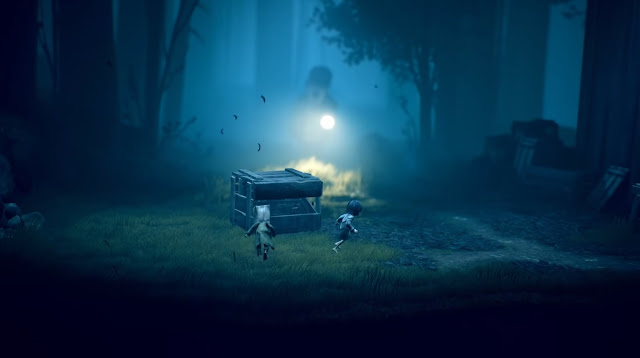
Q1: Of all the games released in 2021, which title impressed (or shocked) you the most? YS:Little Nightmares II. I was impressed by its atmosphere, and could really feel the creators' passion. The animation in particular is excellent.
Little Nightmares II: a puzzle-platformer horror adventure game published by Bandai Namco Entertainment.
Q2: Of the entertainment content that was released or announced during 2021, which one left the deepest impression? YS: "Finch".
Finch: an American post-apocalyptic science fiction drama film starring Tom Hanks, released on Apple TV+.
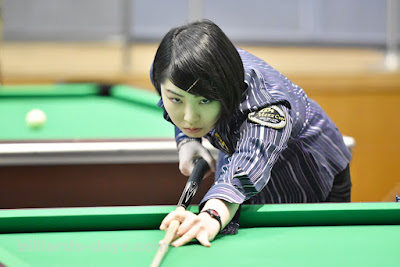
Q3: Which figure personally caught (or is catching) your attention in 2021? YS: [Japanese female professional billiards player] Samia Konishi. I like her decisive, aggressive play.
Samia Konishi
Q4: What are your aspirations for 2022, and what is your message to 4Gamer readers? YS: To the readers of 4Gamer: next year's zodiac sign is the Tiger, which is also Ryo's trademark in Shenmue and can be seen on the back of his jacket. Please look forward to "Shenmue The Animation," which is scheduled to be released in 2022, as we are working to make the world of Shenmue easy to grasp and enjoyable to all.
Shenmue The Animation
This year, Suzuki did not explicitly link his comments to the keyword that he gave recently in the Famitsu survey ("mix") but did provide some insight into his recent game playing with his praise for the atmospheric adventure game Little Nightmares II. Finally, it is clear that Shenmue will play an important role in 2022, notably with the upcoming anime release - whether we may have any other Shenmue-related project announcements is still up for speculation.
Something that has led to a lot of discussion among fans is the nature of the tree that stands gracefully in full bloom at Ternary Spring, outside the house of Grandmaster Feng in Shenmue III. When Ryo visits the area, the tree is mentioned in conversation with both Shenhua and Grandmaster Feng, but nothing is said that would remove doubt about its identity - is it supposed to be an actual Shenmue tree?
The tree at Ternary Spring
This question is not as easily answered as it may at first appear, since the tree is treated inconsistently between Shenmue II and III, as well as between the Japanese and English language versions.
In this post we'll attempt to bring together the known evidence to help judge the tree's true nature.
The Shenmue Dojo forums served as a useful reference for this post, with various theories and discussions made on this topic.
Shenmue Tree Hypothesis
An obvious place to start is by examining the tree's appearance, in particular the pattern of its bark and the shape of its flowers, and compare this to the tree at Shenhua's house which we know from Shenmue II to be a Shenmue tree.
Complicating matters, the Shenmue tree in the third game was considerably reimagined. This is how it looked in the second game:
Appearance of the Shenmue tree in Shenmue II (roots, whole form and blossom)
Every month Phantom River Stone holds a poll among our patrons to choose a topic for the blog in the coming month. After tallying the votes (including accumulated votes from previous months), the winning topic for September 2021 is...
We will be translating an early magazine interview with two legendary music composers who were part of Shenmue's Sound team: Yuzo Koshiro and Takenobu Mitsuyoshi. Among the numerous games for which Yuzo Koshiro has composed music are the Ys series in the late 1980s and the Streets of Rage series in the 1990s, while Takenobu Mitsuyoshi has been composing for Sega games since the 1990s, including work on the Virtua Fighter series and the theme song for Daytona USA.
This interview was published in a January 2000 edition of the Japanese Dreamcast Magazine, soon after Shenmue's release in Japan.
Something that adds greatly to Shenmue's sense of realism are the believable characters that inhabit its world. Each has been carefully crafted, with their own motivations and back-stories, not all of which is necessarily even revealed while playing - how many players will have been astounded to find out perhaps many years later that the "fine and dandy" drunk that stumbled around Dobuita's streets at night is an ex-actor who is in fact only pretending to be drunk?
When Shenmue I and II were released, players had various options to access this extra character information in various forms such as the Shenmue Passport disc (for Shenmue I), magazine features and strategy guidebooks - even if much of this was published only in Japanese. However with Shenmue III, there has been no such guide or character repository for Yu Suzuki's third game in the series.
But now, long-time Shenmue fan Stuart Peacock (otherwise known as Miles Prower on the Shenmue Dojo forums) has released to the community a comprehensive Shenmue III character database.The culmination of a great deal of thorough research and careful investigation, the database contains entries for 300+ characters met or seen in the game, complete with headshot images, names, ages, locations, notes and more, all of it just a few taps away.
Every month Phantom River Stone holds a poll among our patrons to choose a topic for the blog in the coming month. After tallying the votes (including accumulated votes from previous months), the winning topic for August 2021 is...
"Shenmue III English Lines Compared to the Original"
The first two Shenmue games have their share of quirky English translations, and in this topic we'll turn our attention to Shenmue III and look at a number of English lines that may have caused players to wonder how closely they reflect the original Japanese.
These may be anything from a particular word or phrase that relates to the story, to an inconsequential conversation that leaves the player feeling slightly puzzled.
Watch for it to come to the blog in a future post!
"I found it!" - Ryo Hazuki, hunting for Chobu-chan in Niaowu
If Yu Suzuki were to officially release a fruit-themed series of Chobu-chan capsule toys... it might not be far from these.
Meet the Toripicals, Set #3: Watermelon, Blueberries, Lemon, Mango and Fig.
The name of these figures is Toripicals - a word-play on the Japanese word for bird, "tori", and the word Tropical. They are part of a series of fruit-themed capsule-toy sets that were initially released in 2018. Each toy varies in size depending on the fruit variety, with large fruit like the watermelon filling a great part of the capsule toy interior!
As can be seen, these fruity figures give off strong Chobu-chan vibes and with their mix of colors would not be out of place in a Chobu-chan hunt. Some, like the Lemon, come with separate feet to be fitted on to complete the figure.
Peach and Lemon
They appear to also be popular with collectors on social media in Japan:
In addition to the capsule toys, large plushies add to the Toripical line-up.
Ebay Listings
Retro Import Gamer has a small selection of Toripical capsule toy figures available on their Ebay store: Lemon, Blueberries and Mango (all as-new, sealed).
It is still nice to dream of a day YS Net releases an official line of Chobu-chan merchandise!
Following the release of Shenmue III in 2019, fans in the Shenmue community have released a range of mods for the PC version of the game to tweak all sorts of aspects, including graphical and audio adjustments.
Back in 2019, a Shenmue III mod was organized by Patrick Fuller that allowed players to hear Ryo's telephone conversations with Guizhang and Fuku-san voiced by the original voice actor from the first game of the series, Eric Kelso, who specially recorded all the lines for fans to enjoy.
And now a brand new, and much more substantial, Eric Kelso mod has been released by the Shenmue Dojo. Produced once again by Patrick, this mod amazingly swaps in the voice of Wuying Ren as heard in Shenmue II, for Ren's entire part in the game! The recordings have been masterfully and seamlessly integrated back into the game, and hearing Ren's restored voice will bring a smile to the face of fans for whom this is the true voice of Ren.
This mod is the culmination of efforts from the project team, and is credited to the following core team: Patrick Fuller* (producer / director), Lemon Haze (coding), James Brown* (testing / footage), Jibby* (graphic design) and Peter Campbell (audio assistance).
* Also supporters of Phantom River Stone through Patreon!
There is even an added bonus in that Lan Di's lines, although not many in Shenmue III, have been revoiced by voice actor Paul Lucas. They bring back that snarling sense of menace all players will remember from Ryo's encounter at the start of the first game.
Both voice actors are well loved in the community for their ongoing support and participation of the franchise ever since the release of the original games, and have contributed their recordings free of charge. Thanks to their generosity, and the hard work of the Shenmue Dojo project crew, fans playing the PC version now have the option of hearing the original Ren and Lan Di.
This superb mod has already caught the attention of global media (including PCGamer). And hopefully this incredible effort will also come to the attention of producers of the upcoming Shenmue Anime. I'd love to see Eric and Paul back to provide the English voices.
How to Install the PC Mod
Installing the mod is simple. Just follow these steps:
Unzip the zip contents into your Shenmue3\Binaries\Win64 folder.
Download the mod zip. This is the complete version which has the new Ren mod as well as the previous Eric Kelso voices for Ryo's telephone calls with Guizhang and Fuku-san.
Create the folder Shenmue3/Content/Paks/~mods if it does not already exist, and unzip the zip contents into it.
Start the game.
Watch the Scenes
If you don't have a PC, you can watch all the Ren scenes (together with Lan Di at the end!) on the Shenmue Dojo channel:
Near the end of Shenmue II, Ryo and Shenhua take the path from the riverside port of Langhuishan and cross the mountains to eventually reach her father's house, located on a rocky plateau high above the Yingshuihe river.
This familiar location was recreated in Shenmue III, being the place Ryo returns to each evening during his investigations at Bailu village, with a number of minor differences in appearance. In this post we will take a complete tour of this outdoor area, to compare the landscape around the house as it is portrayed in Shenmue II vs Shenmue III (with the house's interior to be covered in a future post).
To start with, let's look down on Shenhua's house from above. The path from Langhuishan / Bailu village can be seen entering from the left side, and continuing past the house in the direction of the Stone Pit. The topography in Shenmue III matches the previous game closely, with one noticeable difference being that the plateau on which the house sits is now wider and less enclosed. The craggy rocks and cliffs are have a somewhat different appearance to the more sheer and flatter shapes seen in Shenmue II.
Bird's eye view of landscape around Shenhua's house (top: S2, below: S3)
Every month Phantom River Stone holds a poll among our patrons to choose a topic for the blog in the coming month. After tallying the votes (including accumulated votes from previous months), the winning topic for the start of 2021 is...
Shenhua's house in Shenmue II vs Shenmue III.
At the end of Shenmue II, after a long journey through the Guilin mountains, Ryo and Shenhua eventually arrive at Shenhua's house, on the outskirts of Bailu village. It is a humble abode in a rural setting, without modern conveniences or even electricity. The player is able to spend some time exploring the house, examining various objects and wall hangings to become quite familiar with its contents and layout.
Shenhua's house features again in Shenmue III, and while it unmistakably represents the same house as the previous game, it is not identical and a number of changes can be noted (what has become of the Luoyang tapestry?).
In this post we'll be comparing and cataloguing as many of the differences as we can.