What's Shenmue is the name of a playable demo that was released in Japan in August 1999, shortly before the full release of Shenmue. It took place in Dobuita Street and involved a short quest in which Ryo has to to locate Mr. Yukawa (a real-life former senior executive at Sega) before a deadline at the end of the day.
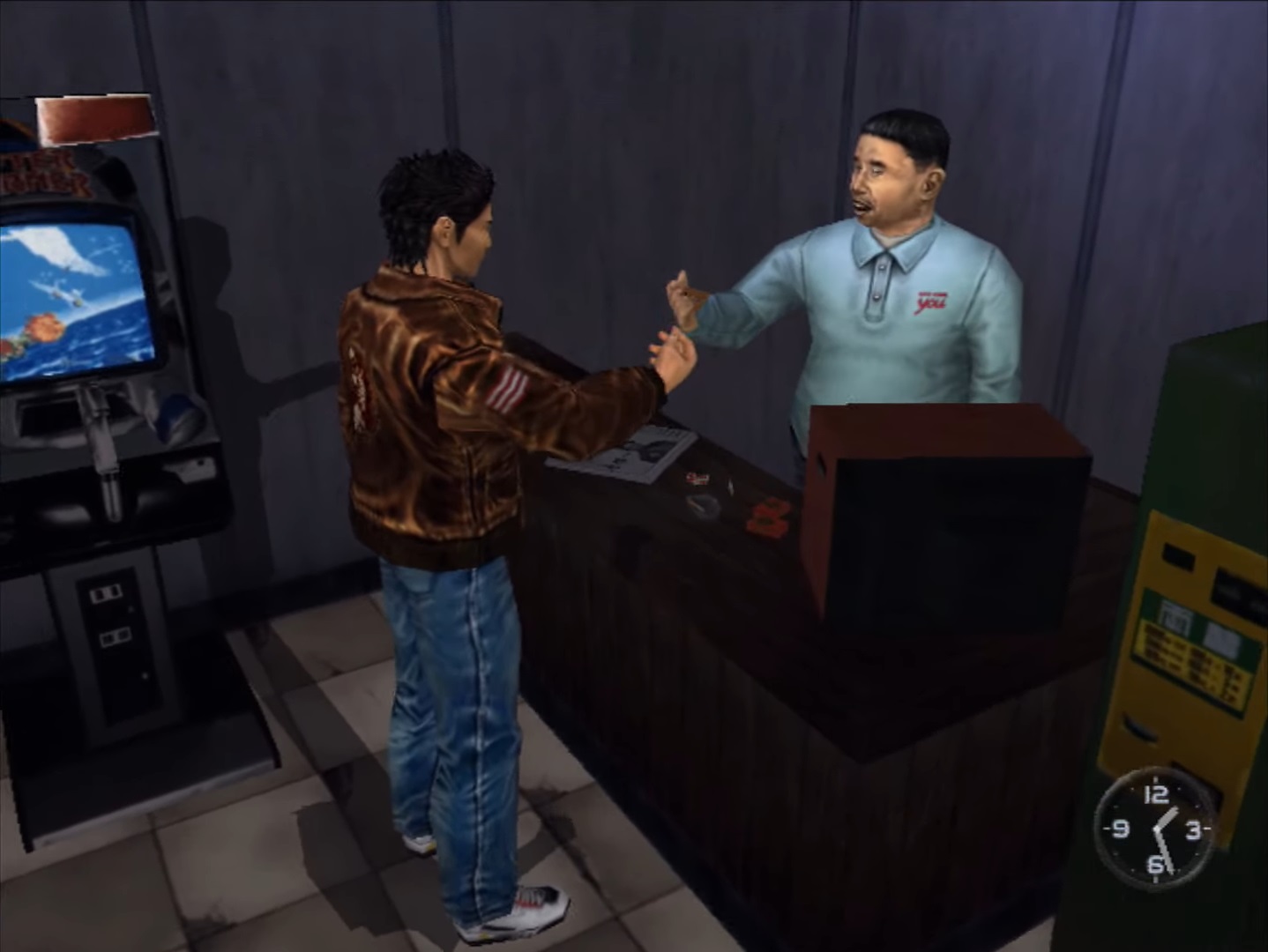
During the quest, Ryo visits the You Arcade where he obtains Mr. Yukawa's business card...
The business card Ryo receives of Hidekazu Yukawa
Details on the front of the card include the SEGA logo, Mr. Yukawa's full name and title (Hidekazu Yukawa, Former Senior Managing Director), his company (Sega Enterprises) and a link to the Shenmue.com website.
A Yu Suzuki character model has been discovered among the files of a Shenmue II prototype that has been recently acquired by members of the Shenmue community. He is dressed in Ryo's classic clothing - leather jacket, white T-shirt, jeans and sneakers - but is otherwise the spitting image of Yu-san. The character even has a somewhat (ahem) "girthier" look compared to Ryo!
Although the character is not available by default, after some adjustments made to the game files, it is now possible to play the game proper entirely as this hybrid "Ryo Suzuki"! The effect is hilarious, as can be previewed in the trailer below.
The existence of a Yu Suzuki character was first mentioned in a tweet from a former Shenmue developer ("ashizuka16bit") back in 2019. It was created by the developers as a fun Easter egg, but unfortunately the idea was rejected by the senior manager and did not make it into the release!
"Shenmue often features developers as general NPCs, but Yu-san actually appeared in Shenmue II as a hidden character. I had a good laugh when I was shown it late at night, but the top development manager found it and put it on hold. If it had been released as it was, it would have caused a stir. By the way, he could be discovered if you searched a certain place [on the way to] Bailu Village"
(Note: the original tweet said "at Bailu Village" but the developer clarified this as meaning "somewhere on the way to Bailu Village", which would suggest during the walk with Shenhua.)
This is just one of the findings that has come out of analysis of an early prototype of Shenmue II that is now in the hands of the community thanks to the generosity and determination of a small group of Shenmue fans: the "Game Jam" prototype.
The "Game Jam" Prototype
This prototype was listed on a Japanese online auction site in March 2022 as a set of four Dreamcast discs, and quickly drew attention.
Photos in the listing showed hand-written labelling on the 4 discs making up the set with the words "Game Jam" and a date of "4/11", indicating that it was used for demonstration at Sega's Game Jam event.
Game Jam was an event was held in Tokyo on the 14th and 15th of April 2001, some months prior to the game's eventual release in Japan in September of that year. Yu Suzuki himself demonstrated the game on stage, and was joined by Masaya Matsukaze and Takumi Hagiwara (Ryo and Ren)
A small group of fans banded together to produce a winning bid on the listing, and in this way have saved it from disappearing once more into a private collection where it might never be seen again.
Not only that, but this group has worked together to analyze the contents in detail, carry out reverse engineering to add and unlock special features, and finally to share not only all their findings but to make available the game prototype itself for all of us to enjoy.
The prototype acquisition was brought about thanks to the following people. A huge shout-out on behalf of the whole Shenmue community for their generosity in procuring this valuable and historical item, as well as their hard work on in-depth analysis.
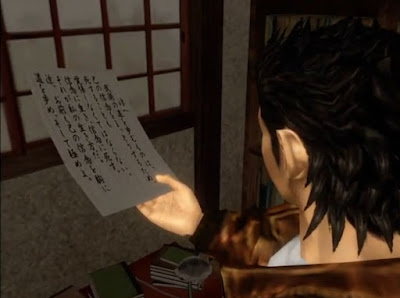
In the first Shenmue game, players discover a note addressed to Ryo from his father Iwao, who seemingly had some inkling that his life was in danger. Reading through this letter is a memorable moment for players of the game.
In fact, it turns out that this is not the only that letter Iwao wrote. There is a second, unused version of Iwao's letter to Ryo that can be found within the game files which we will examine in today's post, and see how it compares to the one used in the game.
Iwao's Letter #1 (Release Version)
In Iwao's letter that Ryo finds in the game, his father gives him advice on being true to one's convictions:
"Dear Ryo... those who follow the path of a warrior, must be prepared to die in order to stand by their convictions. Live for one's convictions, die for one convictions. That is how I lived my life. Ryo, it is up to you to discover your path and follow it through."
Every month Phantom River Stone holds a poll among our patrons to choose a topic for the blog in the coming month. After tallying the votes (including accumulated votes from previous months), the winning topic that has been voted this time is:
"What's Shenmue Unused Assets: Mr. Yukawa business card variants"
What's Shenmue is the name of a playable demo that was released in Japan shortly before the full release of Shenmue. It took place in Dobuita Street and involved a short quest in which Ryo has to to locate Mr. Yukawa (a former senior executive at Sega) before a deadline.
During the quest, Ryo visits the You Arcade where he obtains Mr. Yukawa's business card.
Details on the front of the card include the SEGA logo, Mr. Yukawa's full name and title (Hidekazu Yukawa, Former Senior Managing Director), his company (Sega Enterprises) and a link to the Shenmue.com website.
The back contains a handwritten clue over the Dreamcast swirl that points him to the next location of interest ("After 4pm, Asia Travel Co.").
While this is the card that is used when playing the demo, in fact among the game files are a couple of other minor variations of the Mr. Yukawa business card that would have been produced during its development but not used, but were left behind. We'll be looking at these in an upcoming post.
A photograph that may be of significance has been uncovered among the documents of Shenhua's father in Shenmue II, and suggestions are invited as to the location it shows!
Details follow below.
First, we'll recap the documents that Ryo finds on the desk at Shenhua's house.
Documents on Shenhua's Father's Desk
After Ryo reaches Shenhua's house after their trek over the Guilin mountains, Ryo is invited to explore the house and examine her father's collection of items. Eventually, Ryo finds a desk set in the corner of the bedroom that contains various architectural tools and documents.
Although Ryo would not yet recognize its exact meaning, the uppermost document shows a diagram of caves, with several shapes and lines that the player may later come to realize may represent braziers and other special features that have been installed. The writing itself is too indistinct to reveal any clues.
Every month Phantom River Stone holds a poll among our patrons to choose a topic for the blog in the coming month. After tallying the votes (including accumulated votes from previous months), the winning topic that has been voted this time is:
"Alternative Letter from Iwao to Ryo (Unused Asset)"
In the first game, players discover a note addressed to Ryo from his father Iwao, who seemingly had some inkling that his life was in danger.
In that note, Iwao gives advice to Ryo about being true to one's convictions:
"Dear Ryo... those who follow the path of a warrior, must be prepared to die in order to stand by their convictions. Live for one's convictions, die for one convictions. That is how I lived my life. Ryo, it is up to you to discover your path and follow it through."
Upon reading this, Ryo murmurs "My father must have known that Lan Di was coming..."
Reading through this letter is a memorable moment for players of the game.
In fact a second unused version of Iwao's letter to Ryo exists in the game files. However, although it is not actually shown in the game, we can access the data on disc to read what it says.
In the post we will be examining and translate Iwao's unused letter to see what other advice he had for Ryo.
The jaws of veteran fans dropped on seeing screenshots of an in-game cut scene that is little known to many, including myself: Ryo casually opening a large wooden crate in Master Chen's Warehouse No. 8 in Shenmue I. Images were shared by Japanese fan lu_lu_lu_uesgion Twitter from a livestream playthrough, with the tweet crediting the finding to a viewer on the stream with intimate knowledge of the game.
In this post we'll visit Warehouse No. 8 ourselves and open the crate in question - and also bring out a hacking tool to move the camera around and dig even deeper into the secrets of the mysterious crate!
After Ryo arrives at the warehouse, first walk towards the center of the room, passing around the large crate on the left.
Every month Phantom River Stone holds a poll among our patrons to choose a topic for the blog in the coming month. After tallying the votes (including accumulated votes from previous months), the winning topic that has been voted this time is:
"Cut Content: Screenshots of Miao Village"
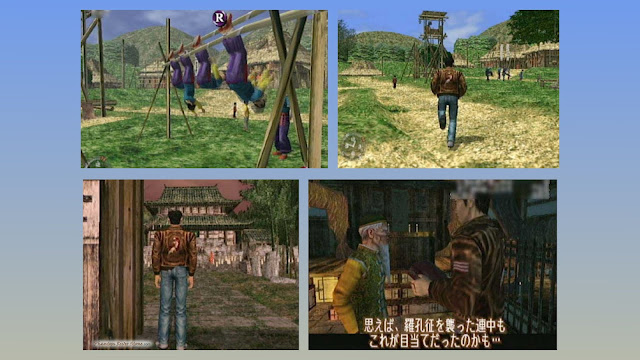
Following the release of Shenmue II on the Dreamcast, a number of intriguing screenshots were revealed by the development team on the Shenmue.com website that appeared to contain content that had been cut from the game before release. They showed an unfamiliar village and temple, and even subtitles of dialogue with an unused character.
Fans later also managed to uncover unused loading screens, one of these showing the name "Miao Village" - this is the name by which the location of these screenshots came to be known by the community.
Various theories have been put forward over the years, although even today, little is known about these screenshots.
Some of the screenshots apparently showing content cut from Shenmue II
In this post, we'll be examining not only the content of these mysterious screenshots, but also as many mentions and references as we can find from available sources from the day and later, in order to build as comprehensive a picture as possible.
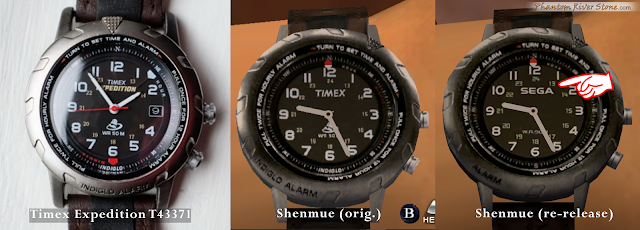
Ryo's trusty Timex watch is a familiar sight to players of the the original Dreamcast and Xbox versions of the first two Shenmue games (although in the Shenmue I & II re-releases, the Timex branding on the dial was replaced with the Sega logo for licensing reasons).
The design was closely based on an actual Timex Expedition T43371, which was released in 1999 just before Shenmue's publication. Hence it did not actually exist at the time of the game's setting of 1986 - something that is not unheard of in Shenmue, with the Sega Saturn at the Hazuki household being one example!
The Timex Expedition (left) served as a model for Ryo's watch in the game (center, right).
The real-life watch is an unusual combination of analogue and digital: the alarm is set by rotating the bezel and triggered by physical contact of wires as the hands move, which triggers an electronic alarm sound.
The sword (katana) and handguard, that latter being a Hazuki family heirloom, play an important role in progressing through the story of the first game. The relationship between these two objects is an enigma, as during the game we learn that, despite their apparent connection, the handguard is not able to be fitted onto the sword blade.
In this post, we will consider the question of whether the handguard was ever meant to have fitted onto the blade, and dig through a number of clues and evidence that were left behind in the game files that indicate that in fact this had been the case - at least during an earlier part of the game's development.
Story spoiler warning: this post discusses how the sword and handguard are used in the game.
Special thanks to SkillJim for his helpful discussions & to LemonHaze for examining the game code for model usage.
The Hazuki handguard (left) and sword blade (right)
Hazuki Family Crest
First, let's look at some of the clues that are already present during the game.
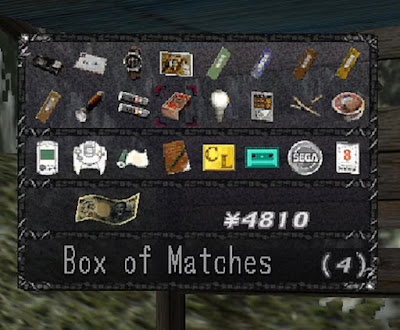
All Shenmue players will be familiar with the inventory screen and its depiction of small icons that represent the things Ryo is carrying at the moment.
An example of Ryo's inventory (Dreamcast)
These inventory icon graphics are of course stored in files on the game disc; but now an earlier version of these icon graphics has been discovered by LemonHaze, project leader of the Dragon & Phoenix project. These are to be found among the game files of the What's Shenmue demo. This was a playable game demo distributed in Japan while Shenmue was still finishing up development, allowing a fascinating glimpse back to an earlier point in the game's development.
Where things get especially interesting are where icons differ from the ones in the final version of the game, with the identity of a few of them being up for debate.
Many thanks to LemonHaze for providing the graphics files and discussion on the icons for presenting in this post.
Below we will walk through each of them to evaluate whether they appear in the released game, and for those that aren't, try to identify what each represents.
The Inventory Item Set from What's Shenmue
The set of icons are stored in two image files on disc, and appear as shown below.
Next we'll step through and comment on each item in turn, starting with the most readily identifiable ones.
Every month Phantom River Stone holds a poll among our patrons to choose a topic for the blog in the coming month. After tallying the votes (including accumulated votes from previous months), the winning topic for October 2021 is...
"Unused Inventory Items Found in Shenmue disc files"
All Shenmue players will be familiar with the inventory screen and its depiction of small icons that represent the things Ryo is carrying at the moment.
Ryo's inventory display (Dreamcast)
As to be expected, the inventory icon graphics themselves are contained within the Shenmue files. A similar, but different, set is also present on the What's Shenmue demo version of the game that was distributed in Japan a few months ahead of the full release.
Where things get interesting is when the What's Shenmue icons are examined more closely. We'll be sharing discoveries made by LemonHaze of the Dragon & Phoenix project, who found a small number of object icons on the earlier What's Shenmue disc that are not used in either game. A few are readily recognizable as objects Ryo interacts with (but does not keep) during the main game, while a couple are harder to identify.
We'll be examining these unused icons in this upcoming post, and with input from readers perhaps they can all be identified.
In a blog post last year we took Ryo Hazuki on an adventure in the sky to visit the moon above Hong Kong (with the help of an out-of-bounds hack), and found that it was modeled as a three-dimensional object moving above the city. In today's post we'll be investigating another noticeable feature of Shenmue II's sky: the sun.
Does the sun move through the sky in the game, in the same way as the moon? How far away is it positioned, and how large does it appear close up? Let's find out.
Scroll to the end of this post to watch the video footage.
The Sun in Shenmue II
The first game in the series introduced its revolutionary Magic Weather system, and while a range of weather and light conditions were simulated, it didn't actually feature a moon or sun in the sky during normal gameplay (the moon did appear during a cut scene in the game).
In Shenmue II, on the other hand, the player's attention is drawn to the presence of the sun right from the start of gameplay, complete with an impressive lens flare effect that can be seen during the opening title sequence as Ryo's ship, the Genpū Maru, docks at Workers Pier.
Lens flare effect in the opening sequence.
The ship slowly docks at the pier, bow first (left). Living up to its name, which means "Mysterious Wind", the ship mysteriously ends up facing in the opposite direction in the next cut of the sequence (right).
Today we have some small but unusual items of unused content to share, courtesy once more of LemonHaze, who ran across them during his work for the upcoming Dragon & Phoenix Collection fan project. They are object models contained within the released Shenmue game files that are not used in the actual game itself.
Development Placeholder Cone
The first is an object that is made of four triangular sides (colored red, yellow, green and blue) arranged together such that they form a square base. LemonHaze explains that this was used during development of the game as "a placeholder object for interactive assets which aren't implemented/made yet".
The placeholder object
It is reminiscent of a traffic cone - hence the filename "pilon" for this object model on disc, as this approximates the pronunciation of the word meaning a traffic cone in Japanese.
The file is located in the Shenmue I game files at MODEL/OBJECT/PILON.MT5, but in fact LemonHaze has spotted the object in actual early footage of Shenmue II, shown in the NHK "Making Of Shenmue" video that was aired on Japanese television in July 1999.
Following the release of Shenmue III in 2019, fans in the Shenmue community have released a range of mods for the PC version of the game to tweak all sorts of aspects, including graphical and audio adjustments.
Back in 2019, a Shenmue III mod was organized by Patrick Fuller that allowed players to hear Ryo's telephone conversations with Guizhang and Fuku-san voiced by the original voice actor from the first game of the series, Eric Kelso, who specially recorded all the lines for fans to enjoy.
And now a brand new, and much more substantial, Eric Kelso mod has been released by the Shenmue Dojo. Produced once again by Patrick, this mod amazingly swaps in the voice of Wuying Ren as heard in Shenmue II, for Ren's entire part in the game! The recordings have been masterfully and seamlessly integrated back into the game, and hearing Ren's restored voice will bring a smile to the face of fans for whom this is the true voice of Ren.
This mod is the culmination of efforts from the project team, and is credited to the following core team: Patrick Fuller* (producer / director), Lemon Haze (coding), James Brown* (testing / footage), Jibby* (graphic design) and Peter Campbell (audio assistance).
* Also supporters of Phantom River Stone through Patreon!
There is even an added bonus in that Lan Di's lines, although not many in Shenmue III, have been revoiced by voice actor Paul Lucas. They bring back that snarling sense of menace all players will remember from Ryo's encounter at the start of the first game.
Both voice actors are well loved in the community for their ongoing support and participation of the franchise ever since the release of the original games, and have contributed their recordings free of charge. Thanks to their generosity, and the hard work of the Shenmue Dojo project crew, fans playing the PC version now have the option of hearing the original Ren and Lan Di.
This superb mod has already caught the attention of global media (including PCGamer). And hopefully this incredible effort will also come to the attention of producers of the upcoming Shenmue Anime. I'd love to see Eric and Paul back to provide the English voices.
How to Install the PC Mod
Installing the mod is simple. Just follow these steps:
Unzip the zip contents into your Shenmue3\Binaries\Win64 folder.
Download the mod zip. This is the complete version which has the new Ren mod as well as the previous Eric Kelso voices for Ryo's telephone calls with Guizhang and Fuku-san.
Create the folder Shenmue3/Content/Paks/~mods if it does not already exist, and unzip the zip contents into it.
Start the game.
Watch the Scenes
If you don't have a PC, you can watch all the Ren scenes (together with Lan Di at the end!) on the Shenmue Dojo channel:
Another new discovery by LemonHaze reveals that a special item of merchandise had once been planned for inclusion among the stock at the Tomato Convenience Store, one that is a key component of Ryo's visual identity: a packet of band-aids.
Ryo stops in at the Tomato Convenience Store to buy a quick item on his way home. (Mock-up)
Let's look at exactly where this extraordinary finding was made.
Tomato Convenience Store: Poo Magazine & More
The Tomato Convenience Store is packed with a range of useful everyday items, from snacks such as Shenmue-branded chocolate through to the gripping content of Poo magazine.
Poo magazine. (The origin of the magazine's title is unknown. It has been suggested that it might refer to the Japanese expression "Pooh-Taro", describing someone who lazes around all day long).
An importance difference between the type of merchandise that can be found is that some items can be picked up and purchased by Ryo, such as the snacks, while others like magazines are purely scenery and stay fixed in place at at all times.
It turns out that there is a special text file that the game uses to help define all the objects in the store that can move, and this is where the new discovery is contained.
Shenmue 2 was the first game in the series to introduce the game of Lucky Hit. A number of stands can be found throughout Hong Kong where Ryo may play to increase his savings, or take on a part-time job and pit his skills against passers-by.
Lucky Hit boards are scattered throughout Aberdeen, Wan Chai and Kowloon, and they offer plenty of variation: each game has its own board size, backing illustration, nail lay-out, payout ratio, rules and rewards. Many of these are easy to miss on a first play-through, being placed in little-used alleyways or sprinkled through the dilapidated buildings of Kowloon.
All these years after the game's release, renowned Shenmue modder and lead of the Dragon and Phoenix project LemonHaze has discovered the existence of a "master settings file" that defines the set-up of all the Lucky Hit boards in Shenmue 2.
Inside this file are several never-before-seen dormant Lucky Hit boards that were disabled before the game's release. LemonHaze has successfully brought these disabled Lucky Hit boards back to life, and they can even be played!
Not only that, but the discovery opens the way to allowing customization of all the Lucky Hit boards in the game.
Let's jump right in to gaze upon a slice of history in the form of the newly-uncovered Lucky Hit boards that were cut before release. For some video footage of the amazing discoveries described here, see the end of the post.
Cut Content Unearthed: New Lucky Hit Boards at the Thunder House
Our location of interest is the "Thunder House" in the Dim Sum Quarter of Kowloon and is the shell of a derelict building that has partially collapsed and is now used as an entertainment area by the locals. It is accessed down a steep set of steps (near the circular arrangement of boards known as the "Lucky Hit Museum").
Entrance to the grandly-named "Thunder House" in Kowloon
The recently-announced Shenmue Dragon & Phoenix project promises almost limitless possibilities for experiencing Shenmue I and II running on the modern Unreal Engine. (See this great overview video and project team interview by Segalacious to learn more).
Such a project naturally involves thorough analysis to evaluate and comprehend the existing game files to ensure the gameplay is ported across accurately; and this also means that the team is perfectly positioned to uncover a wealth of new findings under the hood. As fans are very much aware, the games are so packed with content and secrets that previously-unknown easter eggs are being discovered even to this day.
Today we'll look at an interesting find by the project team - a set of early UI graphics that may even date as far back as the days of Shenmue development for the Sega Saturn!
Players of Shenmue II will be familiar with the mini-maps feature in that game, being displayed onscreen in Hong Kong, if Ryo has purchased a map for the area, and also later in parts of the Guilin section to mark Ryo and Shenhua's progress along the mountain paths.
Something that may come as a surprise is that a mini-map had also been considered for the first game of the series as well at one point in the development. This discovery was reported by user Mestre Ziming on the Shenmue Dojo forums in 2016.
Arriving at New Yokosuka harbor with the mini-map feature in place might have looked like this (mock-up)
The evidence for this lies in remnants left behind in the game files of the released Dreamcast version of the game.
Situated as Sakuragaoka is, on the side of a hill, stone walls are a common sight along the roads that lead to and from the neighborhood. However there is one particular wall that feels a little out of place, and that is the wall that blocks off the end of the road that leads up past the house of Sumiya-san (who can often be found nearby, meticulously sweeping a patch of road near her house entrance).
But investigation of some of the unused map data for the game reveals clues that this road was once been going to continue onwards.