Showing posts with label Shenmue II. Show all posts

Thursday, May 21, 2026

The Director Behind Shenmue II's Cutscenes - Kazuya Murata

Yu Suzuki has mentioned in past interviews that, in order to realize his vision for Shenmue, he needed help from people who didn’t even exist in the game industry yet:

“We didn’t have directors, or anyone used to motion capture, so I gathered people from all kinds of fields: movie staff, scriptwriters, even a novelist.”

One of those outside voices was animation director Kazuya Murata, who joined the Shenmue II team around 1999 and found himself navigating a development floor unlike anything in traditional animation.

Anime director Kazuya Murata

Best known for his work on major anime titles like the worldwide hit Fullmetal Alchemist and the internationally popular Code Geass, Murata stepped far outside the usual animation pipeline when he joined Yu Suzuki’s team midway through Shenmue II’s development. The shift from anime studios to a bustling game production environment brought a whole new set of challenges, from motion-capture sessions to experimental 3D cinematics.

In this 2019 interview, Murata shares what that transition was like and how he adapted to a creative process very different from the one he was used to. His recollections about working with Yu Suzuki and the team shed light on a moment when anime and game production intersected, bringing both new opportunities and practical hurdles.

This interview was released as part of an ongoing series that featured on the official company website of the major Japanese animation studio Toei Animation.

Note: this is a partial translation of the interview. Only the sections related to Shenmue have been translated; unrelated portions have been omitted.


Background of the Interview Series


This long-running series focuses on promoting and deepening understanding of full-CG animation production in Japan. Recently relaunched as “The Future of 3DCG: CG Animation and Media Relations,” the series features interviews with key people involved in CG animation and related media.

About Kazuya Murata

For this entry, we spoke with Kazuya Murata, who served as chief director on the TV anime KADO: The Right Answer, produced by Noguchi (the interviewer for this article and a member of Toei Animation). Murata’s path into the anime industry is an unusual one: he started out as a designer for a housing equipment manufacturer before becoming a trainee at Studio Ghibli. He later worked on CG direction as well, including directing movie scenes for Sega’s Shenmue II. His ability to adapt to CG is often credited to the strong, logical approach to visual composition he developed back in high school.


Interview: Working on Shenmue II


Called in to a Bogged-down Shenmue II Development

Q: Around this time, while you were working at OLM and looking to further build your career as a director, you became involved with the Dreamcast title Shenmue II (2000). How did that come about?

Murata: After finishing the OVA Gunsmith Cats (1995) at OLM, I joined director Naohito Takahashi’s team and worked on Berserk (1997), To Heart (1999), and Steel Angel Kurumi (1999). After that, there was a bit of a gap before the next project.

Around that time, through Shuichi Kakazu, president of an editing studio called J-Film, we were told that Sega was working on their second Shenmue game and was looking for someone who could handle visual direction. They asked whether OLM could send someone over. I personally wasn’t someone who played games at all, but the project sounded like what we’d now call an early open-world game, and I found that interesting. So I ended up being seconded to Sega.

Q: What was the cutscene development process like on Shenmue II?

Murata: I joined what was called the “authoring team,” which was essentially the directing team. Based on scripts handed down from the scenario team, we would go to the motion capture studio, direct the actors’ performances, record the motion data, and then assemble the movie scenes. Once a scene was finished, we’d show it to director Yu Suzuki, receive feedback, and make revisions.

When I joined, there were a lot of retakes coming back from Suzuki-san, and the development on site was pretty much stuck at that point.

Q: When you say there were a lot of retakes, was that because of technical limitations in CG at the time, or because the acting was hard to get right?

Murata: Suzuki-san is very much an inspiration-driven person. He often gave abstract directions like, “Make it a bit more powerful.” The authoring team would then interpret that, reassemble the cuts, or redo the motion capture, but no matter how long it went on, we wouldn’t get an OK from him. Eventually, everyone stopped knowing what to do.

That’s when it was decided that someone was needed to establish a clear directing approach, and that’s why an animation director was brought in.

Q: I’ve heard that Shenmue had an enormous development budget, and I feel like I understand one of the reasons why now.

Murata: Apparently, before me they had brought in people like live-action directors, but it didn’t work out. Live-action and games have very different workflows, so they ended up leaving. Knowing that background, I figured what was being asked of me was to find a balance between the director’s vision, the script, and what the game world itself required, while also producing something that felt clear and comfortable for the player to watch.

So the first thing I did was create storyboards as a rough foundation. I showed them to the actors as well, clearly indicating from which direction the camera was capturing each moment, and we moved forward from there.

An example of Shenmue II storyboard planning: "Encounter with Shenhua". Murata describes introducing storyboards like this to bring clarity to camera direction and motion capture. More Shenmue II storyboards can be viewed here.

Q: Did things start to run more smoothly once you introduced storyboards?

Murata: Yes. There were still times when something didn’t pass, but compared to how things had been stalled before, we could clearly feel that approvals were coming through and the project was moving forward again. More than anything, motion capture became much more efficient, and the amount of time each operator needed to assemble scenes around the captured motion dropped dramatically.

Q: At the time, I imagine this was your first experience directing 3DCG. Did it feel very different from what you were used to?

Murata: When I was helping out on the theatrical Pokémon films, I did have some interaction with the CG team, but this was the first time I was involved with CG to this extent. When drawing storyboards for hand-drawn animation, you have to be careful when moving the camera so the background perspective doesn’t need to change. But Suzuki-san had been intentionally moving the camera very aggressively ever since Shenmue Chapter One (1999), to emphasize that it was 3DCG.

I actually pushed back against that. Even if something is CG, camera movement that isn’t driven by a clear directorial need just becomes visual noise for the viewer. That kind of approach had already been rejected in Hollywood by that point, so I felt it would be a step backward. That said, I understood what the director was aiming for. If every shot were completely fixed, the advantages of using 3DCG would be diminished. So we worked toward camera movement that felt natural and effective in 3D, without being overbearing.

Q: Were there any directing challenges that were unique to Shenmue?

Murata: One of Shenmue’s defining features is that even though we called them "movie" cutscenes, they weren’t pre-rendered. They’re actually real-time rendered parts of the game itself. The game world has its own internal clock, and time continues to pass regardless of what the player is doing. That means the same event might take place during the day or at night depending on the player’s actions.

Meeting Joy cutscene (day)

Meeting Joy cutscene (night)

On top of that, one of the selling points was that NPCs moved around freely on their own 24 hours a day, so the people in the background of a scene would constantly change as well. Our job, then, was to design combinations of acting and camera work, deciding what to frame and how much to show, so that the scene would still look good no matter when it was triggered. Since we couldn’t know the lighting conditions in advance, we couldn’t prepare fixed lighting effects, and that added another layer of difficulty.

Q: It’s often said that differences in terminology and workplace culture between the anime industry and the game industry can lead to communication problems. How did you deal with that?

Murata: As far as 3DCG was concerned, that wasn’t much of an issue for me. Back when I worked at Matsushita Electric Works, I was already using 3D software for design work, so I understood how three-dimensional forms are constructed within a space. I didn’t feel much resistance there, and I generally knew how to communicate things to the CG staff.

On Shenmue II, our team received completed data from the character and background teams and then focused on directing it. Compared to anime directing, it felt more passive, like being one part of a larger production flow.

Q: I’ve heard that at the time, the CG industry had many technically skilled people but not many who could handle direction. Given that, it seems like your participation, with experience in both CG and directing, must have left a real impact.

Murata: One great thing about the Shenmue team was that more than a hundred people were all working on the same floor. There were teams for movie direction, character modeling, background art, scenario writing, game events, motion capture, and then about 30 programmers in the systems development department. They weren’t just programming the game itself, but also building and constantly updating the game engine tools used by each team, which really impressed me.

Part of the Shenmue project office floor (from the Making of Shenmue documentary)

For example, if we said it was hard to adjust the camera, they’d create tools to make camera work easier. Another distinctive thing was that camera work itself was done using a game controller. From a gamer’s perspective, I suppose it makes sense - the controller you use every day ends up being the easiest way to move things.

Q: What's your take on motion capture?

Murata: I think it really depends on how you use it. One advantage of motion capture is that you’re recording a performer’s acting directly, which allows for subtle movements or irregular motions that animators might not think of on their own. Also, once you’ve recorded the performance, you can consider the acting itself essentially complete, which dramatically reduces the amount of time compared to fully hand-keyed animation.

On the other hand, motion capture depends heavily on the individuality of the actor. In live-action, that individuality is the value of the work. But with motion capture, one actor might perform multiple characters, or multiple actors might perform the same character, so you don’t get a one-to-one relationship between actor and role. In that sense, it’s actually closer to the relationship between a hand-drawn animator and a character.

Because of that, I think motion capture often needs a later adjustment process, similar to animation direction or animation director checks, where the captured motion is treated as a base and then refined.

There was one thing about Shenmue that really impressed me. Character movement in Shenmue was fundamentally built around motion capture, but at the time the capture precision wasn’t very high, so a lot of noise crept into the data. The motion team spent their days cleaning up that data and refining the movements.

Sega's motion capture studio (from the Making of Shenmue documentary)

As a result, we started to see people who could create very realistic, live-action-style motion entirely by hand, even without any capture data. Sometimes it actually looked more lifelike than the motion capture we were used to seeing. When I asked, “What is this motion?” the answer was, “It’s all hand-keyed” (laughs).

Q: (laughs) That’s an incredible amount of learning just from input alone.

Murata: Exactly. For those people, hand-keyed motion didn’t come from an “anime-style” way of thinking. It was based on real, live-action movement. Someone with that kind of skill can create animation that looks like motion capture whenever they want (laughs). Of course, these were experienced, senior-level staff, but it really made me realize how people grow in that kind of production environment.

-- End of translated section --

Kazuya Murata

Source (2019, Japanese) 

Final Comment

Murata mentions that one of his first steps on Shenmue II was to create and use storyboards to clarify camera direction and performance before shooting motion capture. If you’re curious what real Shenmue II storyboards look like and how they compare to the final in-game cutscenes, we examined several of them in detail in a previous post.

Regarding handling communication with experts from outside the game industry, we have previously heard Yu Suzuki comment on this in his 2019 interview with IGN Japan:
"The industry didn't have directors, or people experienced at motion capture - it was a new concept. Games didn't have things like voiced lines or acting. So to implement it, I gathered people from various different industries: a movie person, a scriptwriter, a novelist and so on".

However, this resulted in a communication problem, as the experts all used different industry-specific terminology and specialist language. "They couldn't understand what I was trying to say at all".

In order to make it easier to understand for everyone in the team, Yu wrote the story in the form of a novel with the classic four-part narrative structure of Introduction, Development, Twist and Conclusion. In addition, he expressed it musically, composing a four-movement symphony.

"I asked myself what would be a form that everyone would understood in common - and that was music and story."

This may be the first time we've heard from one of the directors who worked on the game's cutscenes, and it adds another piece of the jigsaw, fitting in nicely with past interview comments and art materials.

Become a Patron!

Monday, December 8, 2025

Poll Result: Patrons' Choice Topic for December 2025

Every month Phantom River Stone holds a poll among our patrons to choose a topic for the blog in the coming month. After tallying the votes (including accumulated votes from previous months), the winning topic that has been voted this time is:

"Interview: Toei Director Kazuya Murata's Experience Working on Shenmue II"

In interviews, Yu Suzuki has mentioned that, in order to realize his vision for Shenmue, he needed help from people who didn’t even exist in the game industry yet:

“We didn’t have directors, or anyone used to motion capture… so I gathered people from all kinds of fields: movie staff, scriptwriters, even a novelist.”
One of those outside voices was anime director Kazuya Murata, who joined the Shenmue II team around 1999 and found himself navigating a development floor unlike anything in traditional animation.

Best known for his work on major anime titles like the world-wide hit Fullmetal Alchemist and the internationally popular Code Geass, Murata stepped far outside the usual animation pipeline when he joined Yu Suzuki’s team midway through Shenmue II’s development. The shift from anime studios to a bustling game production environment brought a whole new set of challenges, from motion-capture sessions to experimental 3D cinematics.

In a 2019 interview, Murata shares what that transition was like and how he adapted to a creative process very different from the one he was used to. His recollections about working with Yu Suzuki and team shed light on a moment when anime and game production intersected, bringing both new opportunities and practical hurdles.

Coming soon to the blog!

Become a Patron!

Thursday, April 17, 2025

Shenmue 2 Interview with Yu Suzuki | DoriMaga May 2001

This interview with Yu Suzuki about the upcoming release of Shenmue II for Dreamcast was published in the May 2001 edition of Japan's DoriMaga magazine. It took place following Sega's decision to cease production of the Dreamcast a couple of months earlier in March 2001.

The translation begins below.

DoriMaga: There was a huge turnout at SEGA's recent event, Game Jam*, reaffirming the great anticipation for Shenmue II. What plans are there for the Dreamcast in future, and what is the significance of Shenmue II? Let's hear a message from Yu Suzuki to the readers of the new-look DoriMaga magazine and users of the Dreamcast.

*Note from Switch: Game Jam was a trade event held in Tokyo by SEGA the previous month, in April 2001, and featured preview gameplay of Shenmue II.

Suzuki: Game Jam was fantastic. While we apologize for any inconvenience caused due to the crowded space, we are delighted that so many people attended. Seeing such a large number of attendees makes us very happy. Seeing so many attendees on that day made me think, "It's a shame we're giving up on the Dreamcast..."
DoriMaga: The event featured the first-ever demonstration using actual hardware, but how far along is the development of Shenmue II at this point?
Suzuki: Well, as of the end of March, it's mostly been bug fixes. That means we've essentially locked in the program code, and from there, it's mostly about replacing data and focusing on debugging. Since April, we've been diving into that work, and at the moment, we're at a stage where it's nearing the finalization process. At this stage, if we are able to iron out any critical bugs, we'll be looking at finalization in just a few weeks.
Become a Patron!

Sunday, January 12, 2025

Examining Shenmue II Storyboards | Design Documents

In the Spring of 2022, a promotional event was held on location in Yokosuka to celebrate the anime adaptation of Shenmue, Shenmue The Animation, which was organized by Yokosuka City in collaboration with SEGA and IGN Japan. Various pieces of concept artwork were exhibited at a number of shops in the area, some being from the anime while others were sketches and illustrations from the time of development of the first two games.

Among the artwork were reproductions of certain storyboards from the game, detailing the camera shots and spoken lines to guide creation of cut scenes in the game. 


The three storyboards exhibited at the event which we will cover in this post are from Shenmue II and are entitled:

  1. "Encounter with Joy"
  2. "Xiuying's Tears"
  3. "Encounter with Shenhua"

We will be looking at these in more detail and translating any written notes and characters' lines, noting differences of interest between the storyboards and the final implementation of the cut scenes in the game.


Become a Patron!

Saturday, October 5, 2024

[Part Eleven] The Secret of Miao Village: Working Cut Scene & Team Battle Event Discovered!

It is time to add to our Miao Village series with the announcement of an exciting discovery of a working section of cut game play, making this the first time we have ever experienced Miao Village cut content in a playable form!

This incredible finding was discovered by Brian Park, who runs the Shenmue Park account on X/Twitter, after intense efforts. On a recent Shenmue Dojo stream, Brian commented that he had "checked through thousands of entry points" (referring to the debug menu available on certain prototypes of the game) over the last few months before finding it.

The part of the story relates to Ryo's meeting with Zhang regarding the whereabouts of Yuanda Zhu, and Brian has made a video that captures everything. Not only does it contain a brand-new cut scene and QTE event, but (depending on the outcome of the event) it can even develop into a team battle with Ryo and Zhang taking on a gang of thugs!

The dialogue in the ending cut scene matches exactly with the Zhang meeting subtitle text for the Miao Village storyline that we examined previously. However we now see additional interactions between the two prior to this discussion - and it also reveals that their meeting place was not the Dou Jiang Diner, as had been assumed, but Lotus Park in South Carmain Quarter.


Video

Watch the incredible footage of the full cut scene from the Game Jam prototype, from Brian Park, which includes the QTE success & fail scenarios as well as other variations of the scene found on Disc 2 and in the unreleased US Shenmue prototype:


You'll note that the voices are not those of the official voice actors for the release. Due to the scene being still under development at this point, stand-in voices were used (for example, those of staff or developers) as placeholders until the scenes were finalized.

Credit for screen shots in this post to Brian Park (taken from his video).


Cut Scene, QTE and Team Battle: Synopsis & Dialogue Translation

Here is a synopsis of the interactions that occur in this extended cut scene, which also includes a QTE interaction and - depending on whether you succeed or fail at this - a team battle together with Zhang against the loan sharks!

Ryo enters Lotus Park, which appears to be empty, and looks around as if searching for someone.

A few seconds later, a man in a brown suit walks out from behind a tree, and bows. It is Zhang.

Become a Patron!

Wednesday, March 13, 2024

Does the Chawan Sign in Shenmue Have a Historical Basis?

Today, we will do a deep dive into an iconic communication method seen in Shenmue: the Chawan Sign, which Ryo first learns about in Shenmue II (and is reintroduced later in one of the Shenmue III DLC stories). He makes use of the Chawan Sign to discreetly communicate with allies, by arranging teacups in a certain pattern in a public place, 

Arranging four teacups

Ryo is warned that placing them at the wrong location, or carelessly arranging them in the wrong pattern, can result in unwanted attention...

Trying at the wrong location may attract trouble

But was the concept of the Chawan Sign something that Yu Suzuki and team created purely for Shenmue, or did it have some kind of historical basis?

In this post, we will try to answer this question by looking at a possible sources of inspiration.

Become a Patron!

Thursday, December 14, 2023

Two Pre-Release Screenshots of Langhuishan Village in Shenmue 2 | Analysis

Today we will examine two early-development screenshots of Ryo's arrival in Guilin from a Japanese magazine from the time of Shenmue II's development, showcasing the charming riverside village of Langhuishan.

Accompany an article about Shenmue in Japan's Famitsu DC magazine in February 2001, these images offer a fascinating glimpse into how its design changed during the game's development.

Langhuishan (Feb 2001 image 1)

Langhuishan (Feb 2001 image 2)

Analysis of Langhuishan Image 1


The first image depicts Langhuishan's village square, overlooking the tranquil river. A comparison with the final release version of the game reveals some intriguing differences:

Langhuishan view towards river showing a stall in the early screenshot (top) that was relocated in the release version (bottom)

The background mountains and dock are almost unchanged in the release, but the pre-release image features an additional element: a vegetable stand beside the dock, facing away from the river.

Become a Patron!

Thursday, April 27, 2023

Mystery Location in Photo at Shenhua's House Identified? | Shenmue II

Last year, we posted an article about an unidentified photo that can be glimpsed at Shenhua's house in Shenmue II.

The photo can be partially seen on the desk in Shenhua's father's room, in the pile where Ryo finds the plans for the Phoenix and Dragon mirrors. But there is no way for the player to move the other papers aside to examine it, and Ryo makes no comment about it.

It is, however, possible to view the full photo by accessing the game files directly, which looks as below. It appears to be some kind of outdoor scene with arches, trees, and some kind of structure in the center:

The mystery photo uncovered

In our post about this photo, we posed the question of why this photo would have been present among the design documents (albeit largely obscured), whether it had any significance and - most of all - whether such a location exists or existed in real life.

Well now, a possible candidate for this mystery location has been identified!

Become a Patron!

Tuesday, April 11, 2023

Former Developer Anecdote: Shenmue II's Duck Racing Was Created In Secret

A former Shenmue developer has shared a brief but amusing anecdote in response to a tweet from Shenmue Forever that praised Shenmue II's intricate duck racing Easter Egg.

In his tweet, the developer that revealed that the entire duck race event was in fact created secretly by the Game Director* and staff without Yu Suzuki's knowledge!

An image of the original tweet is shown below.

Source tweet

About Satoru Tsuji

Satoru Tsuji (Twitter account mame_XPERIA) was one of the member of SEGA's 7-person Event Planning team on the Shenmue II project. He mentions that he was in charge of the fortune tellers in the game.

* Note: Tsuji's tweet about the duck race partially censors the Game Director's name as "Oka***". At first I assumed this might be (Keiji) Okayasu, however the Shenmue II end credits confirm this refers to Yoshihiro Okabayashi, who both headed the Event Planning team and was one of Shenmue II's two Game Directors.
Shenmue II End Credits: Event Planning team


Guide to Duck Racing in Shenmue II

Video: Shenmue Fans channel


Become a Patron!

Monday, February 27, 2023

Shenhua's Home Renovations - What Changed in Shenmue III

It has been a while since our earlier post on the blog in which we looked at changes in appearance to the exterior of Shenhua's house and the surrounding landscape from Shenmue II compared to Shenmue III. In this post, we'll turn our attention to the house's interior to cover what changes have been made within.

House Footprint

One notable difference seen from external observation, even before Ryo steps inside, is that Shenhua's house in Shenmue III has a difference in shape compared to Shenmue II.

Originally, the house's footprint was previously a simple "L" shape:

Shenhua's house, Shenmue II

However in the later game, the right-hand side of the house has been extended with a new wing:

Shenhua's house, Shenmue III
Become a Patron!

Monday, August 8, 2022

[Part Nine] The Secret of Miao Village: Dialogue Revelations & Sequence of Events (Cont.)

In this post we complete our examination of the Key Story Beats for the Miao Village arc with the final entries 7 to 10, highlighting conversations found in the recent Game Jam prototype of Shenmue II.

Miao Village Story Arc Recap to This Point, Entries 1-6:

Ryo speaks with Zhang, who claims to be Yuanda Zhu's aide and asks Ryo to retrieve the second volume of the Wulinshu martial arts book from a man named Kongzheng Luo who lives in Miao Village. Ryo volunteers to assist the elderly owner at Sunny Capital Pharmacy by delivering some herbs to Miao Village by bicycle, together with his niece Xiaoqing. After carrying out this task, Ryo then asks passers-by as to Kongzheng's whereabouts and learns that he was killed two weeks earlier.

We now pick up again with Ryo looking for a way to get inside Kongzheng's house, which is locked up, to search for more clues about his death.


Become a Patron!

Monday, August 1, 2022

[Part Eight] The Secret of Miao Village: Dialogue Revelations & Sequence of Events

Recently, a previously-unseen Shenmue II prototype was successfully purchased at an online auction and, thanks to the generosity of the group behind the purchase, it was shortly afterwards released to the community. This discs were marked "Game Jam," which was the name of an event that occurred in April 2001.

Related post:
Perhaps one of the biggest questions at the forefront of the minds of many fans was whether the prototype would help reveal anything more on the topic of the legendary Miao Village that had been cut early in development.


And this proved to be the case! Shortly after the prototype's release to the community, the discovery of a wealth of Miao Village related dialogue content on the discs, in the form of Japanese subtitle files for conversations and events, was announced on the Shenmue Dojo forums by veteran Shenmue hacker LanDC (link to thread and discussion) with detailed explanations of several key conversation sections.

It is now possible to piece together a comprehensive picture of the cut story content, and confirm at last what had once been theories and suppositions: how Miao Village was to have been integrated into the main story, details of the bicycle quest with Xiaoqin, and the true meaning of the dialogue seen in the AM2 screenshots all those years ago.

Starting with today's post, we will be presenting as much of the newly-found Game Jam dialogue as possible, and present it in a logical order that reflects the most likely sequence of events relating to the Miao Village content.

Notes:
  • The conversations shown here have been translated from the Japanese dialogue data extracted from in the Game Jam discs. The original Japanese text is also provided for reference with each conversational interaction.
  • The original dialogue content that remains on the Game Jam version covers only a subset of all the characters that would have once been part of the Miao Village subplot, however it is still substantial enough to draw useful conclusions.
  • Some notes have been added in italics, such as to indicate when a character is pointing, or when new information has been learned that gives Ryo a new objective. These are speculations based on the dialogue context.
  • The Shenmue II order has been followed for the names of Chinese characters e.g. Lishao Tao (rather than Tao Li Shao). 
  • A selection of conversations with various characters has been included, included repeated questioning, to demonstrate the variety of interactions through which Ryo is able to acquire clues.

Miao Village Story Arc: Key Story Beats


Below are the key story beats that can be identified in the cut subplot. They have been assembled into an order that appears to fit the content best. 
  1. Cut Scene: Meeting Zhang & a Mission to Retrieve the Second Volume of the Wulinshu
  2. Searching for a Way to Miao Village
  3. Visiting Sunny Capital Pharmacy & a Bicycle Delivery Quest
  4. Medicine Delivery at Miao Village
  5. Looking for Kongzheng Luo's House
  6. A. The Fate of Kongzheng Luo
    B. Master Yunhai's Friendship with Kongzheng Luo
  7. A. Finding a Way to Enter Kongzheng Luo's House
    B. Obtaining the House Key
    C. Identifying the Boy in the Photo
  8. Talking with Zhengye Luo
  9. Cut Scene: Visiting Master Yunhai at Miao Guang Temple
  10. Delivering the Wulinshu to Zhang
We'll run through each of these in detail.

Starting Point of the Miao Village Cut Content


The first relevant dialogue is a cut scene, that takes place with Yuanda Zhu's aide, Zhang. At this point in the story, it can be assumed that the following events have occurred as they do in the release version of the game:
  • Ryo has met Lishao Tao and discovered the Wulinshu in the library at Man Mo Temple. Inside the book he found a note with the Chawan Sign, which serves as his next clue to locating Yuanda Zhu.
  • After making the Chawan Sign at the Dou Jiang Diner, he has met with a man in a brown suit, who we later find out is named Zhang, who revealed that he serves Yuanda Zhu. However before Ryo had a chance to ask him any questions, several thugs burst into the restaurant and abducted Zhang.
  • A QTE event played out in which Ryo chases after the thugs - dodging a watermelon projectile in the process - and Zhang was rescued, thanks to the invisible help of Xiuying.
Ambush at the Dou Jiang Diner (screenshot from release version)

This brings us to the likely point of the first scene of cut content we will be looking at, in which Ryo talks with Zhang once again after the thugs have been defeated.
Become a Patron!

Wednesday, July 13, 2022

[Part Seven] The Secret of Miao Village: Content Reborn | Shenmue III

Welcome to Part Seven of our analysis of cut-content screenshots of the mysterious "Miao Village" and temple that were revealed in 2002 on the Shenmue.com website by AM2, Yu Suzuki's development team at Sega.

Parts in the series:

  1. Village Screenshots Analysis
  2. Village Content Left Behind
  3. The House in Xiuying and Ziming's Flashback
  4. Temple Screenshots Analysis
  5. Temple Content Left Behind 
  6. The Original Plan for Miao Village in Shenmue II
  7. Content Reborn [this post]
  8. Dialogue Revelations & Sequence of Events
  9. Dialogue Revelations & Sequence of Events (Cont.)
  10. Extra Dialogue & Facts Collected

Traces of Original Miao Village Dialogue

Before diving into the post, you may be aware of the exciting news since the previous part in this series, with a previously unseen Shenmue prototype - known as the "Game Jam" prototype from the event for which it was created - being acquired at auction by a small group of fans and generously shared with the community. Not only does it hilariously contain a Yu Suzuki character model, but a set of conversational dialogue subtitles that directly relate to Miao Village was discovered hidden within the files. These finally allow us to piece together many missing pieces of the puzzle and put to rest certain questions held over so many years.

In today's part, however, we look at how several of the concepts that had been planned for the scrapped Miao Village ended up appearing in partial or reworked form, many years later, in the most recent game in the series: Shenmue III.

Thanks to George & Joe Kitchen for their helpful input.


Bailu Village & Its Inspiration


As concluded in the previous part, Miao Village was to have been located in the vicinity of Wan Chai, Hong Kong. It was not planned to represent the story's Bailu Village, which is located much further north in the Guilin region of China - however, they do share many similarities.

As Ryo travels with Shenhua over the mountains of Guilin in Shenmue II, she talks often about 
Bailu Village, and the various conversations with her during the walk portray a small, closely-knit but isolated village. (A full set of the conversations with Shenhua can be found here on BlueMue's video channel).

Here is a selection of information learned from Shenhua about Bailu village during the journey:

  • Bailu Village is one of the oldest villages in Guilin, existing since the Tang Dynasty
  • It has a population of about 50 people.
  • The village well is the source of drinking water.
  • Most houses are made from wooden pillars and earthen walls. There are also houses made from stone. Glass is not used because once broken, it can't be repaired. Shenhua's house is like a typical house in the village.
  • A picture of a god is placed at the entrance to a house to protect from devils and evil spirits.
  • Most villagers cultivate the fields and own water buffalo or goats. Horses are also kept for transportation.
  • One of the villagers has a huge carp. Carp are cooked on New Year's or when there's something to celebrate.
  • The village also has ancient buildings that housed treasures and rare items, protected by strong walls, built long ago by the nobles from the city.
  • There is a herbal pharmacy but no hospital in the village.
  • Stone lions are placed at road intersections.

Regarding the inspiration for Bailu Village, Yu Suzuki has stated that is inspired by ethnic Chinese villages such as those of the Miao people:
"There are villages called Miao villages that belong to an ethnic minority. Ethnic minorities like the Miao, Iyan or Kam inhabit villages in the interior region of Guilin. I'm creating Bailu Village with those kinds of villages in mind".

- Yu Suzuki (Shenmue Master interview at Gamescom 2017, Germany)  

This would imply that the ideas and designs from Miao Village would fit equally as well in Bailu Village, and there is evidence that this is the case in the rendition of Bailu that made its appearance in Shenmue III.

Yu Suzuki at Gamescom in 2017 (Shenmue Master interview)

Become a Patron!

Friday, May 20, 2022

[Part Six] The Secret of Miao Village: Original Plan for Miao Village in Shenmue II

Welcome to Part Six of our analysis of cut-content screenshots of the mysterious "Miao Village" and temple that were revealed in 2002 on the Shenmue.com website by AM2, Yu Suzuki's development team at Sega.

Parts in the series:

  1. Village Screenshots Analysis
  2. Village Content Left Behind
  3. The House in Xiuying and Ziming's Flashback
  4. Temple Screenshots Analysis
  5. Temple Content Left Behind 
  6. The Original Plan for Miao Village in Shenmue II [this post]
  7. Content Reborn
  8. Dialogue Revelations & Sequence of Events
  9. Dialogue Revelations & Sequence of Events (Cont.)
  10. Extra Dialogue & Facts Collected
  11. Cut Scene Discovered!
In this post, we'll investigate the original intention for the Miao Village shown in the cut-content screenshots.


Note: an early Shenmue II prototype that was created for the GameJam event in 2001 has just been released to the community, and this holds a lot of potential for new discoveries. This article was completed prior to the release of the prototype but, in anticipation, an eighth part has been added to the current series, for any new findings!

Theories Over the Years


For many years since the screenshots were first made public in 2002, there has been much speculation among players as to where in the story the village (and temple) was to have fit. Some ideas discussed among posters on the Shenmue Dojo forums included:
  • Based on the village's link with the Miao people, who mainly inhabit the mountains of southern China: located somewhere in Guilin, for example on the way to Bailu Village.
  • More specifically, one area that raised eyebrows as a possible location is the transition to the Green Field area just after Langhuishan, as there is a distinct disconnect in scenery (e.g. the path's appearance and mountain shapes):
  • Located near Luoyang.
  • It might have been intended to be Bailu Village itself.
  • One location that was not given a great deal of attention is Hong Kong itself, presumably due to the rural setting of the screenshots.
For many years, little concrete information was available to back up or disprove these theories. It was not until much later, with Shenmue III going into development, that direct references were made by some of the original developers that helped to shed some light on the topic.

The highest profile comment was from Shenmue's main character design artist, Kenji Miyawaki.
Become a Patron!

Hidden Yu Suzuki Model Unearthed in Shenmue 2 | "Game Jam" Prototype Release!


A Yu Suzuki character model has been discovered among the files of a Shenmue II prototype that has been recently acquired by members of the Shenmue community. He is dressed in Ryo's classic clothing - leather jacket, white T-shirt, jeans and sneakers - but is otherwise the spitting image of Yu-san. The character even has a somewhat (ahem) "girthier" look compared to Ryo!

Although the character is not available by default, after some adjustments made to the game files, it is now possible to play the game proper entirely as this hybrid "Ryo Suzuki"! The effect is hilarious, as can be previewed in the trailer below.


The existence of a Yu Suzuki character was first mentioned in a tweet from a former Shenmue developer ("ashizuka16bit") back in 2019. It was created by the developers as a fun Easter egg, but unfortunately the idea was rejected by the senior manager and did not make it into the release!
"Shenmue often features developers as general NPCs, but Yu-san actually appeared in Shenmue II as a hidden character. I had a good laugh when I was shown it late at night, but the top development manager found it and put it on hold. If it had been released as it was, it would have caused a stir. By the way, he could be discovered if you searched a certain place [on the way to] Bailu Village"
(Note: the original tweet said "at Bailu Village" but the developer clarified this as meaning "somewhere on the way to Bailu Village", which would suggest during the walk with Shenhua.)

This is just one of the findings that has come out of analysis of an early prototype of Shenmue II that is now in the hands of the community thanks to the generosity and determination of a small group of Shenmue fans: the "Game Jam" prototype.

The "Game Jam" Prototype

This prototype was listed on a Japanese online auction site in March 2022 as a set of four Dreamcast discs, and quickly drew attention.

Photos in the listing showed hand-written labelling on the 4 discs making up the set with the words "Game Jam" and a date of "4/11", indicating that it was used for demonstration at Sega's Game Jam event.

Game Jam was an event was held in Tokyo on the 14th and 15th of April 2001, some months prior to the game's eventual release in Japan in September of that year. Yu Suzuki himself demonstrated the game on stage, and was joined by Masaya Matsukaze and Takumi Hagiwara (Ryo and Ren)

A small group of fans banded together to produce a winning bid on the listing, and in this way have saved it from disappearing once more into a private collection where it might never be seen again.

Not only that, but this group has worked together to analyze the contents in detail, carry out reverse engineering to add and unlock special features, and finally to share not only all their findings but to make available the game prototype itself for all of us to enjoy.

The prototype acquisition was brought about thanks to the following people. A huge shout-out on behalf of the whole Shenmue community for their generosity in procuring this valuable and historical item, as well as their hard work on in-depth analysis.

Become a Patron!

Friday, May 6, 2022

[Part Five] The Secret of Miao Village: Temple Content Left Behind

Welcome to Part Five of our analysis of cut-content screenshots of the mysterious "Miao Village" and temple that were revealed in 2002 on the Shenmue.com website by AM2, Yu Suzuki's development team at Sega.

Parts in the series:

  1. Village Screenshots Analysis
  2. Village Content Left Behind
  3. The House in Xiuying and Ziming's Flashback
  4. Temple Screenshots Analysis
  5. Temple Content Left Behind [this post]
  6. The Original Plan for Miao Village in Shenmue II
  7. Content Reborn
  8. Dialogue Revelations & Sequence of Events
  9. Dialogue Revelations & Sequence of Events (Cont.)
  10. Extra Dialogue & Facts Collected
  11. Cut Scene Discovered!
In this post, we will gather together any content to be found among the disc files that may have once been part of the temple location seen in the screenshots.

Name of the Temple


Just as an unused "Miao Village" loading screen was uncovered by fans (see Part Two), a second unused loading screen was also found that provides the name of this temple. If running a build of Shenmue II that has a debug menu, this can be viewed by setting the area code to SMMK:
Debug menu: settings for displaying the temple loading screen

Doing so will display the following loading screen, which has the name "Miao Guang Temple" (as with the Miao Village loading screen, it fails to continue past this point):

The Miao Guang Temple loading screen (the time and date are default values)

The area code for this loading screen, SMMK, matches the four-character prefix seen in the filename for the object model representing the red-cover version of the Wulinshu (seen in Ryo's hands in the temple screenshot), confirming that it is the same temple.

Next, we'll look for models of objects or buildings on the disc. You may recall that Part Two's earlier investigation into the village screenshots turned up fragments of village houses actually included in the released game in an unexpected area: the gloomy corridors of the first couple of floors of the Yellow Heads Building. It turns out there are further pieces of scenery to be found there that relate to the temple location.
Become a Patron!

Tuesday, April 26, 2022

[Part Four] The Secret of Miao Village: Temple Screenshots Analysis

Welcome to Part Four of our analysis of cut-content screenshots of the mysterious "Miao Village" and temple that were revealed in 2002 on the Shenmue.com website by AM2, Yu Suzuki's development team at Sega.

Parts in the series:

  1. Village Screenshots Analysis
  2. Village Content Left Behind
  3. The House in Xiuying and Ziming's Flashback
  4. Temple Screenshots Analysis [this post]
  5. Temple Content Left Behind 
  6. The Original Plan for Miao Village in Shenmue II
  7. Content Reborn
  8. Dialogue Revelations & Sequence of Events
  9. Dialogue Revelations & Sequence of Events (Cont.)
  10. Extra Dialogue & Facts Collected
  11. Cut Scene Discovered!
In this part, we will now turn our attention to the remaining four screenshots of a temple location:

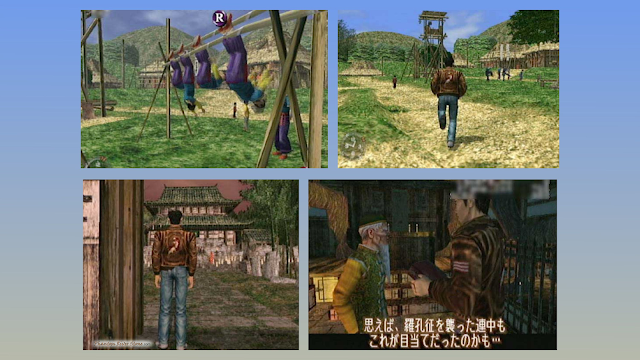
The four "cut content" screenshots of a temple

Order of the Screenshots


We saw previously with the village screenshots, that the images originally presented on the Muecas page are not necessarily in time sequence order; keeping this in mind, we will consider whether any change in order may be appropriate.

Temple Screenshot 1/4: Exterior


The image of Ryo outside is clearly the first in the sequence.

Screenshot 1: temple grounds


Become a Patron!