The Origins: The First Sacred Spot Guide Map (2017)
![]() |
| Original version cover (Japanese) |
![]() |
| Original version cover (Japanese) |
Welcome to the fourth and final part of our review of the art renders shared by AM2 developer Hideki Kawabata (previous parts: Part One, Part Two, Part Three). This final post in the series will touch on some of the location renders and promotional CG art that was included in the collection.
The first location we'll look at is one that once lived only in the imagination of fans: the stadium in which Ryo's high school karate tournament took place prior to the start of the first game, as revealed by Yu Suzuki in 2015:
Q: Where did Ryo get his band-aid?
Yu Suzuki: It didn't appear in Chapter 1, but there was a martial arts event. The scar is from the final match.
This response is from a Twitter event called "#YouAskYu" in 2015 - a transcript is archived on the old Shenmue Dojo forums.
This took on a concrete form in recent years, when a scene from this tournament was included in the first episode of Shenmue The Animation in 2022. For the anime, the tournament location was directly based on the real-life sporting venue, the Yokosuka Arena:
![]() |
| The location of the karate tournament in Shenmue The Animation: Yokosuka Arena |
Every month Phantom River Stone holds a poll among our patrons to choose a topic for the blog in the coming month. After tallying the votes (including any accumulated from previous months), the winning topic this time is:
Sacred Spot Guide Map - Shenmue The Animation (English Version)
The superb Shenmue Sacred Spot Guide Map is a multi-page tourist pamphlet highlighting locations of interest to Shenmue fans around Yokosuka, created through a collaborative effort between Yokosuka City and SEGA.
The guide map was first released at the end of 2017, impressing fans with its high quality and thoughtful detail.
![]() |
| Original version (Japanese) |
![]() |
| Shenmue I & II version (Japanese) |
![]() |
| Shenmue The Animation version (Japanese) |
Not only that, but versions were produced in both Japanese and English, catering to a wide range of tourists and fans visiting the area.
The most recent version is the Shenmue The Animation English version, printed some time after the Japanese edition and its existence is perhaps not as widely known.
In this post, we'll summarize the differences between the three versions - along with download links - so you can find them all in one handy place.
Coming soon to the blog!
Become a Patron!Today is Part Three, the final part, of our exploration of the art from Yokosuka City's Shenmue anime celebration!
Links to the previous parts:
Special thanks: thanks again to も_なお Mo_Nao for kindly providing the source photos from the event, to which cropping & straightening has been applied. Be sure to follow her on X (Twitter) at @greed_air for a heap of original Shenmue content!
![]() |
| "Come Over Guest House, Wan Chai (night)" |
![]() |
| "Wan Chai (morning)" |
Welcome back to our exploration of Yokosuka City's Shenmue anime celebration! In Part One, we delved into some intriguing concept art and sketches from the game's early days and the anime's creation.
Now, in Part Two of this mini-series, we'll uncover more captivating art from the streets of Dobuita that were on display during the event.
Let's continue our visual journey through Shenmue's world.
Special thanks to も_なお Mo_Nao for kindly providing her photos taken at the event, to which cropping & straightening has been applied. Be sure to follow her on X (Twitter) at @greed_air for a heap of original Shenmue content!
![]() |
| "At the Hazuki Residence gate" |
![]() |
| Verny Park, Yokosuka (image credit: 怪猫) |
![]() |
| Two special guests (image credit: 怪猫) |
| A wonderful memento from EREN(echo) Small treats and gifts were shared out, and one of the group had kindly visited the tourist office beforehand to gather Shenmue guide maps. The generosity of Shenmue fans knows no bounds! |
Nagaura Port is the real-life harbor on which New Yokosuka Harbor in the first game is modeled. True to its depiction in the game, it can be reached by a short ride from the bus stop near Dobuita Street. This post contains photos that highlight how close certain features of the real-life location still match today with the game's 1986 version.
![]() |
| Current-day Nagaura Port |
![]() |
| Ryo admires New Yokosuka Harbor |
Every month Phantom River Stone holds a poll among our patrons to choose a topic for the blog in the coming month. After tallying the votes (including accumulated votes from previous months), the winning topic that has been voted this time is:
"Concept Art from the Shenmue The Animation Promotional Event in Dobuita (2022)"Engaku-ji is the name of a peaceful temple compound in Kamakura, Japan that houses over twenty temples and halls, and is considered to be one of the most important Zen Buddhist complexes in Japan.
![]() |
| At Engaku-ji |
On visiting the temple, a small cave entrance can be discovered at one side, just off the main path, with a stone post next to it engraved with the kanji characters of its name.
| A mysterious cave |
How did this cave come to have this name? A sign nearby gives some additional background.
| White Deer Cave |
Kamakura is a place we know Yu Suzuki has visited in the past - a recent example being with the Kickstarter super backers on the day of their Kickstarter Backer Dinner. Perhaps Yu Suzuki and team were inspired in the naming of Bailu Village through this very legend.
Since its debut in December 2017, a result of a collaboration between Yokosuka City and SEGA, the Shenmue Sacred Spot Guide Map has become an essential companion for Shenmue enthusiasts exploring the nostalgic charm of real-life Dobuita Street and the surrounding area. This sought-after map holds the key to exploring many of the real-life locations that inspired the immersive world of the first game. From the serene Suwadai Shrine to Kurita's military surplus store, visitors can uncover the connections between reality and the virtual realm, stepping into the footprints of Ryo Hazuki in his hometown.
![]() |
| Covers: original (left) and Tokyo Game Show 2018 (right) |
![]() |
| Cover: Shenmue The Animation version |
![]() |
| Shenmue The Animation version: inner pages |
"Especially since you bought merchandise..."
Located in Nagano city - not strictly speaking a convenience store but a Tomato-branded supermarket!
For the last two months, a promotion to celebrate the release of Shenmue The Animation has been running in Yokosuka. I went down to check out each of the eight stores participating in the promotion. This post has a selection of photos from the visit.
Four of the participating stores were on Dobuita Street itself:
Inside each participating store, Shenmue-related artwork and sketches were on display, and they also had Shenmue anime postcards to give away with a purchase of 500 yen. The owners were all very friendly and welcoming to Shenmue fans, and I managed to persuade some of them to strike a pose for the blog photo!
| East Gate of Yokosuka-chūo station |
![]() |
| Left: the cover of the Shenmue Sacred Spot map. Right: a leaflet about the current promotion, known as the "Anime Celebration Project" |
| Main road near the station |
15th May 2022 sadly marked the closure of a restaurant that will have special meaning for fans of Shenmue as having been a potential stop on any "Shenmue the Animation pilgrimage" for a few short months.
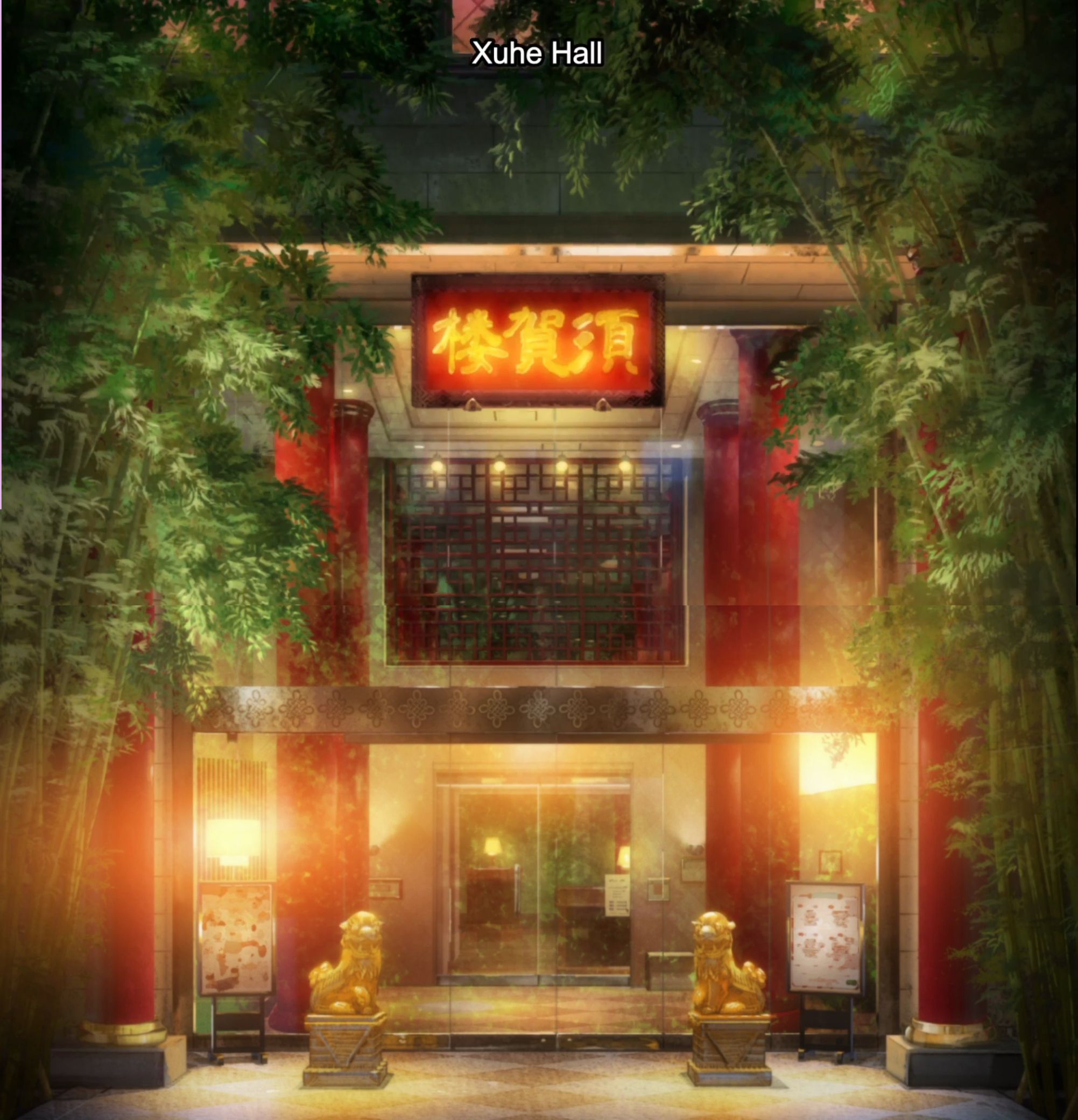
The restaurant's exterior and interior served as models for the venue seen in Episode 3 of Shenmue the Animation called "Xuhe Hall", which is visited by Lan Di in order to extract information about the whereabouts of the mirrors from the owner.
![]() |
| Xuhe Hall exterior (Shenmue the Animation) |
![]() |
| Xuhe Hall interior (Shenmue the Animation) |
The real-life restaurant's name is Heichinrou and was the flagship store for the chain throughout Japan. It was the oldest existing restaurant in Yokohama Chinatown, and is closing after more than 130 years in business.
News outlets initially suggested that plans for a possible relocation were being considered, but a more recent news item has reported that this main branch of the restaurant has filed for bankruptcy after struggling through the effects of the COVID-19 pandemic, so reopening would appear unlikely.
However, to capture the last days of the restaurant while still in operation, I went along just before opening time on the last day to take some on-location pictures. The manager (I don't think he was the one in the anime!) kindly granted permission for me to also take some of the interior.
Become a Patron!"There's this guy I know of, Yang, who worked for Yuanda."
In Episode 10, Ren gives Ryo a possible lead in Kowloon - a location which is introduced with a panning shot of a crowded high-rise blocks of apartment buildings with a plane soaring overhead.
Although Kowloon Walled City was demolished in 1993, this scene is in fact directly modeled on a location which exists today. It is an apartment tower called Montane Manion, which is located on King's Road in Quarry Bay.
![]() |
| Montane Mansion, Quarry Bay (photos by George Kitchen) |
The crowded, run-down aesthetic is certainly strongly reminiscent of the Kowloon Walled City that once existed.
Xuhe Hall is the name of the restaurant Lan Di visits in Episode 3 of Shenmue The Animation to pressure the owner for information on the mirrors taken out of China.
It is not just the exterior that has been reproduced, however; the interior also serves as the model for the anime's depiction, which was spotted by George Kitchen:
As mentioned previously, Heichinrou Yokohama branch will be closing on 15 May, 2022 to move location, so if you are in the area plan a visit soon!.