Showing posts with label Eigo Kasahara. Show all posts

Wednesday, August 19, 2026

World Guidance Guidebook: Shenmue Developers Survey (May 2000) - Part Two

In Part One, we began our translation of an extensive survey of 57 Shenmue developers published in the World Guidance guidebook in May 2000, shortly after the game’s original release. Having heard from members of the Sound & Music and Graphics Design teams, we now continue with responses from the Game Development and Planning teams.


Keiji Okayasu

Role: Game Director

Keiji Okayasu with Yu Suzuki in 2000

Q. What do you like about Shenmue?
A. The variety and depth of the mini-games.

Q. Who is your favorite character, and why?
A. The Santa who appears at Christmas. His lines are simply funny, and he’s a limited-time character on top of that.

Santa Maeno

Q. What scene left the deepest impression on you?
A. The Jimmy chase scene. During the QTE, there’s a moment where Ryo spins around someone to dodge them. The first time I saw that, I thought, “Whoa, that’s cool!”

QTE: chasing Jimmy through Dobuita

Become a Patron!

Wednesday, October 8, 2025

Anecdotes & Insights - The Spirit of Shenmue Lives On | Famitsu Dec 2024 [Part 6]

In this post, we present the final part of our English translation of Famitsu’s 25th anniversary roundtable with the original Shenmue developers. In Part 5, the team recounted the challenges of building Shenmue II, reflected on the long road until Shenmue III, and shared their hopes for seeing the series reach its conclusion one day.

In this final part, the discussion closes with a message from actor Masaya Matsukaze, the voice of Ryo Hazuki in the Japanese version, who shares his memories of the series’ early days and what Shenmue has meant to him. The developers then reflect on their own experiences and the lasting impact Shenmue has had on their lives, careers, and friendships.


What Does Shenmue Mean to Each of You?


—As we begin to wrap things up, we’ve received a comment from Masaya Matsukaze, who plays Ryo Hazuki. Let us share it with you now.

Masaya Matsukaze – 25th Anniversary Comment


"I have so many memories tied to Shenmue that I don’t even know where to start...

First off, let me talk about the audition. It was all extremely top-secret, and a ton of people participated. One thing that really stuck with me was being told, “Bring a personal seal (inkan) to stamp the confidentiality agreement - if you don’t have it, you’ll be sent home.” I remember thinking that was pretty strange, and also telling myself, “If I forget it, I won’t just fail the audition, I won’t even be allowed to apply, which would be ridiculous,” so I made extra sure not to forget it.

By some miracle, I passed the audition. I later heard the reason I got the role was, “We knew the production would be tough, so we chose someone who looked sturdy and had a good personality.”

A few years later, the game was finally announced with a press event at Pacifico Yokohama! After years of keeping everything confidential and working in a secret facility, without even telling my own parents, Shenmue was finally going public. But during preparations for my own appearance on stage, we ran into a problem during the costume check. Apparently, it was felt that “Matsukaze’s outfit is lame.” So at the last minute, on the night before the event, I had to run to a department store in Tokyo and buy a whole new outfit! There wasn’t time for tailoring, so the fit was a little off - that’s another memory that sticks with me.

Once, in the dressing room for the motion capture, the actor Yukijiro Hotaru said to me, “You’re still young, right Matsukaze? While you’re young, you should try everything. Later on, you’ll naturally start to weed out the things you don’t want to do, and that’s how you’ll find the path you should take.” I’ve lived by those words ever since. The advice I've received from Yu Suzuki and Hiroshi Fujioka is also something I treasure. The people I met through Shenmue have had a profound impact on who I am today.

Cancellation, then revival - when I was told “The series will be put on hold after II,” I was so shocked it felt like my heart stopped. We had already recorded so much motion capture for what came next... Then, years later, when I heard the words, “We’re making a sequel!” I was absolutely speechless. And then came the anime... Shenmue is full of surprises. You truly never know what’ll happen next. I could go on and on forever.

Oh, and speaking of which - I recently made Ryo’s leather jacket as a hobby project!"

See the full video on Matsukaze's YouTube channel

Become a Patron!

Monday, October 6, 2025

Anecdotes & Insights - From Shenmue II to Shenmue IV | Famitsu Dec 2024 [Part 5]

In this post, we continue our English translation of Famitsu’s 25th anniversary roundtable with the original Shenmue developers. In Part 4, the team reflected on Shenmue’s enduring legacy and casually revealed that a fully playable PlayStation 2 version of Chapter One once existed but was never released.

Part 5 turns to the creation of Shenmue II, an ambitious sequel built on a rewritten engine and systems to support its larger scale. The developers also share stories from the Shenmue III era and reflect on the possibility of Shenmue IV, discussing their hopes for seeing the story completed one day.


Development of the Even More Expansive Shenmue II


—So far we've mostly been talking about Shenmue I, but were there any specific hardships during the development of Shenmue II?

Hirai: I was responsible for all the system programming in Shenmue II, but as for the other parts of the game, that was almost entirely handled by Mr. Wada.

Wada: The first game was set in a small Japanese town. You didn’t need too many people on screen, the streets were narrow and had lots of corners, so you didn’t have to draw things too far into the distance. But Shenmue II was set in a massive city, Hong Kong, so we had to show more people on-screen, and draw much further into the distance to make the city feel alive and expansive.

When we looked at that, it became obvious: there was absolutely no way to achieve that using the system from Shenmue I. I talked with Hirai and the tech team, and we ultimately decided we had to rebuild everything from scratch.

Hirai: The scripting system, the engine, even the C-language parser - we basically changed all of it. At the time, I was also involved with Space Channel 5 Part 2, so if issues cropped up, I would temporarily shift my focus back to Shenmue II to help out.

Become a Patron!

Saturday, October 4, 2025

Anecdotes & Insights - Shenmue’s Legacy and the Unreleased PS2 Port | Famitsu Dec 2024 [Part 4]

In this post, we continue our English translation of Famitsu’s 25th anniversary roundtable with the original Shenmue developers. In Part 3, the group discussed Hirai’s “Shenmue Maker” system, the unique team culture under Yu Suzuki, and the creative energy that fueled the project’s breakthroughs.

Part 4 explores Shenmue’s lasting impact on the developers’ lives and the wider industry - and, casually dropped into the conversation, comes the revelation that a fully functional PlayStation 2 port was developed but never released!


Shenmue's Pivotal Role in the Developers' Lives

Okayasu: I think Shenmue really changed the lives of a lot of the people who worked on it.

—A lot of staff came and went during its development. How did all of you feel about that constant turnover?

Okayasu: It was honestly just a "throw more people at it" kind of strategy - pure manpower tactics. And that meant some of the new staff were competent, but others were completely useless.

Kasahara: We had people coming in as "programmers" who had never even written a line of code. It was total chaos. There were even people whose only job was to go out and recruit others. Their performance was judged by how many people they brought in - once they delivered someone, their job was done.

—Ahhh... so the whole staffing and operational system was unstructured, and individual tasks didn’t necessarily add up to meaningful progress overall.

Matsuda: Which made things a nightmare for those of us actually on the ground.

Okayasu: Matsuda, what did you think when you got caught up in what we called the "Shenmue Hunt" and you were told to join the Shenmue team?

Matsuda: Oh, I didn’t even get a say in whether I joined the team or not. It wasn’t optional. I still clearly remember that it was right before my very first summer vacation as a new graduate.

Before joining the Shenmue team, I was thinking, “Wow, AM2 really works hard. Pretty intense,” but I figured I’d take a nice break over summer and refresh myself. Then, right before the break, my manager called me in and said (doing an impression), “Matsuda… there’s this game called Shenmue. We’re short on people. The time has come for your talents to be of use. You want to grow as a designer, don’t you?”

And the moment I said, “Yes!” my summer vacation disappeared.

Everyone: (laughs)

Kasahara: That voice impression was actually kind of close. (laughs)

Become a Patron!

Friday, October 3, 2025

Anecdotes & Insights - "Shenmue Maker" & Yokosuka's One-Year Build | Famitsu Dec 2024 [Part 3]

In this post, we continue our English translation of Famitsu’s 25th anniversary roundtable with the original Shenmue developers. In Part 2, the team shared tales of late nights and endless debugging, reflecting the uncompromising standards that defined the project.

Part 3 highlights Takeshi Hirai’s ingenious “Shenmue Maker” system that kept all 88 programmers in sync, and dives into anecdotes about working under Yu Suzuki, including the Zushi Marina retreats where late-night debates (and drinks) helped shape Shenmue’s vision. We also hear a special anniversary message from Yu Suzuki himself.


Hirai's "Shenmue Maker" Programming Concept

— Were there any other parts of the programming that were especially difficult?

Hirai: The "games within a game" at the You Arcade were pretty tough. You can play Space Harrier, Hang-On, and so on inside the game. But to do that, we had to temporarily set aside the data from the main game, load and run the arcade game, and then after playing, return to the main game - and deal with the fact that various internal data would come back completely scrambled. Getting everything to cleanly return to the way it was, as if nothing had happened, and seamlessly resume the main story... that was actually a pretty complex process.

— I see.

Kurooka: Here’s a funny one - you know the capsule toy machines, right? Well, one of the items you can get is Sonic. But Sonic was the only one modeled with an unusually high polygon count, and during development, there was this bug where the game would crash whenever you got Sonic.

Become a Patron!

Thursday, October 2, 2025

Anecdotes & Insights - Shenmue Devs on Crunch & Debugging | Famitsu Dec 2024 [Part 2]

In this post, we continue our English translation of Famitsu’s 25th anniversary roundtable with the original Shenmue developers. In Part 1, the team recalled the brutal work culture, the “general election” that decided the lead programmer, and how some staff turned themselves into NPCs.

Part 2 turns to the harsh realities of debugging, with stories of cardboard naps, 24-hour shifts, bizarre bugs, and the obsessive attention to detail that made Shenmue both a nightmare to create and a one-of-a-kind masterpiece.

The Harshness of the Development Environment

Hirai: You really shouldn’t be starting meetings at 10 p.m., right? We did have a nap room, though. That said, my previous company wasn’t very different, so I thought, “Ah, it’s the same here too.” That was just the era we were in. Still, during Shenmue’s development, I felt way more pressure. I remember seeing my timecard showing "XX" hours for a single month.

Note from Switch: The original article did not provide the exact figures; “XX”/“YY” are placeholders for the actual numbers.

Kasahara: If we’re talking about work hours, then it has to be Wada. Like we mentioned earlier, when you looked at his timecard, he’d barely gone home all month. And he wasn’t the kind of guy to fudge the numbers or cheat the system either. His recorded hours for one month were something like "YY" hours.

— (We could only laugh.) I mean, there are only about 720 hours in a month, assuming 24 hours times 30 days.

Hirai: Wada was known as the ‘mainstay’ of the team. He was always present in the office - that’s how dedicated he was. And he wasn’t even a full-time employee! (laughs)

Kasahara: No matter when you showed up, he was always there.

— Mr. Wada, why were you working that much...?

Wada: I was a contract employee, and I originally worked at another company doing various types of development, but I was brought onto Shenmue under contract. And the content of that contract was to “see Shenmue through to release.” So I felt that unless the game shipped, I hadn’t fulfilled my responsibility. I was just doing what I believed was required of me.

To put it simply, I just didn’t go home for two months. (laughs)

Especially toward the end of development, we had about two solid months of debugging, and the team had to operate 24 hours a day. There were times during debugging when the game would crash, and the testers would be stuck, unable to do anything, until morning. That happened several times, but with no programmers around at those hours, the bugs couldn’t be fixed.

Once someone said, “We can’t do any debugging because there’s no programmer here,” I realized I had to be available around the clock. After that, I basically worked 24 hours a day.

Ryo catches some sleep... unlike some of the developers [Image added by Switch]

Become a Patron!

Wednesday, October 1, 2025

Anecdotes & Insights - Shenmue Devs Celebrate 25 Years | Famitsu Dec 2024 [Part 1]

To celebrate the 25th anniversary of Shenmue's release on the Dreamcast in Japan, Famitsu.com invited several former project members to reminisce over dinner about their experience working to create the masterpiece that is Shenmue and reflect on the game's legacy.

Left to right: Takeshi Hirai, Eigo Kasahara, Makoto Wada, Keiji Okayasu, Kenji Miyawaki, Takashi Matsuda, Toshiyuki Kurooka

The participants were key members from the original Shenmue development team:

  • Eigo Kasahara, who served as Planning Director for Shenmue I and II, and also worked on the Shenmue Passport and the PS4 remaster.
  • Makoto Wada, a programmer on Shenmue I and lead programmer on II.
  • Takeshi Hirai, the main system programmer on Shenmue I.
  • Keiji Okayasu, the Assistant Director on Shenmue I, II, and III.
  • Toshiyuki Kurooka, a programmer on Shenmue I, who focused on events around the Hazuki residence and the basement. 
  • Takashi Matsuda, a CG designer on Shenmue I and II who created many of the game's NPCs. 
  • Kenji Miyawaki, a graphic designer responsible for character designs and UI across the series.
The discussion is full of fun stories and inside jokes, while at the same time revealing just how intense the work environment was at the time, and the immense dedication shown by the development team to bringing the games to life. Not to mention the startling revelation that a PS2 port of Shenmue I was developed internally but never released...

"I didn't go home for two months." - One of the dinner participants.

"This isn't that kind of game!" - Yu Suzuki, upon discovering that the developers had implemented boob jiggle physics.

"We created Yokosuka from scratch in just one year - after the game's announcement (at the Shenmue Premiere)" - Takeshi Hirai.

The article translation starts below.

Become a Patron!

Wednesday, July 9, 2025

Poll Result: Patrons' Choice Topic for July 2025

Every month Phantom River Stone holds a poll among our patrons to choose a topic for the blog in the coming month. After tallying the votes (including accumulated votes from previous months), the winning topic that has been voted this time is:

Famitsu.com article: 25th Anniversary Shenmue Reunion with Key Former Developers

To celebrate the 25th anniversary of Shenmue's release on the Dreamcast in Japan, Famitsu.com invited several former project members to reminisce over dinner about their experience of working to create the masterpiece that is Shenmue and reflect on the game's legacy.

Left to right: Takeshi Hirai, Eigo Kasahara, Makoto Wada, Keiji Okayasu, Kenji Miyawaki, Takashi Matsuda, Toshiyuki Kurooka

The participants consisted of key members from the original Shenmue development team:

  • Eigo Kasahara, who served as Planning Director for Shenmue I and II, and also worked on the Shenmue Passport and the PS4 remaster.
  • Makoto Wada, a programmer on Shenmue I and lead programmer on II.
  • Takeshi Hirai, the main system programmer on Shenmue I.
  • Keiji Okayasu, the Assistant Director on Shenmue I, II, and III.
  • Toshiyuki Kurooka, a programmer on Shenmue I, who focused on events around the Hazuki residence & the basement. 
  • Takashi Matsuda, a CG designer on Shenmue I and II who created many of the game's NPCs. 
  • Kenji Miyawaki, a graphic designer responsible for character designs and UI across the series.
The discussion is full of fun stories and inside jokes, while at the same time revealing just how intense the work environment was at the time, and the immense dedication shown by the development team to bringing the games to life. Not to mention the startling revelation that a PS2 port of Shenmue I was developed internally but never released...

"I didn't go home for two months." - one of the dinner participants.

"This isn't that kind of game!" - Yu Suzuki, upon discovering that the developers had implemented boob jiggle physics.

"We created Yokosuka from scratch in just one year - after the game's announcement (at the Shenmue Premiere)" - Takeshi Hirai.

Coming soon to the blog!

Become a Patron!

Thursday, April 4, 2024

Sega's Precautions with Phone Numbers in Shenmue

On its initial release in Japan in December 1999, Shenmue impressed players with its realistic settings and attention to detail.

One such detail was the accuracy with which phone calls were reproduced in order to check the weather forecast, speak with Nozomi or gain access to Warehouse No. 8. Local phone numbers even had the correct area code for Yokosuka city (0468). 

This proved to be a slight headache for Sega, as some of the eager players tried actually calling the numbers. While the numbers used in the game were said to have been reserved beforehand by Sega to prevent nuisance calls, nonetheless a warning was issued in the February 2000 edition of the Weekly AM2 online magazine (which we recently translated) asking players to refrain from trying to call the numbers.

"Attention: Regarding the phone numbers used in Shenmue

The phone numbers used in the game Shenmue Chapter 1: Yokosuka are intentionally designed not to allow actual calls. Recently, there has been an increase in attempted calls, leading to nuisances such as wrong numbers.

We kindly request your cooperation to refrain from making actual calls. Thank you for your understanding".

More on this topic was revealed in an interview with Shenmue game director Eigo Kasahara in Adam Sipione's Shenmue Documentary, "A Gamers Journey: The Definitive History of Shenmue" 

Eigo Kasahara: Yu-san wanted to display the proper area codes in the game. The problem we raised was that players would try to call them. And we couldn't just make something up. In which case, Yu-san proposed we get hold of those phone numbers. We wondered how many we should get. We ended up getting about five.

When he gave us that instruction, the first thing we did was to check whether there was anyone at Sega who lived in Yokosuka and in fact there was one person who did. So we approached that person and explained that we wanted to obtain five phone lines, with any costs of course being covered by Sega. His house already had a telephone connection, although it didn't have an actual telephone. So we were able to obtain four, I think it was, real phone numbers.

At that time, there was someone who actually tried calling the number for Master Chen. Apparently, when he heard a proper ringing tone, he got spooked and hung up! However, the phone numbers were all ones where definitely nobody would answer.

In truth, I had been thinking of having them connect in the future to something like "Shenmue Fun Facts", although that part didn't get implemented.

Those numbers were actually held for several years afterwards. Then the Sega employee who had let us obtain the numbers informed us that he would be retiring, and asked us to do something about those phone lines. So we actually went along and arranged the infrastructure work needed to deregister the phone numbers.

Eigo Kasahara was also in charge of the Shenmue I & II re-releases, and he explained that he took the opportunity to avoid potential problems by shortening the phone numbers used in the game by omitting the last digit:

Eigo Kasahara: These days, we don't know where they connect to, and registering phone numbers was out of the question at this late stage, so for the remake we abandoned that idea and dropped a digit instead. 

Wishing everyone a Happy Shenmue Day!


Become a Patron!

Wednesday, February 22, 2023

Weekly AM2 Vol. 7: Interview with Shenmue Planning Director, Eigo Kasahara | 25th Jan 2000

In this series we translate Shenmue content from Weekly AM2, the official online magazine published by Sega's AM2 development team back in the day. News and information about the Shenmue series could be found regularly within these pages from the end of 1999 through to 2001 with the release of Shenmue II.

Vol. 7 contains an interview with Shenmue Planning Director, Eigo Kasahara (who also returned to manage the localization for Shenmue I & II many years later). There is also an announcement of the prizes for the Network Ranking competition, as well as another Shenmue digital wallpaper.

-Switch


Vol.6: 2000.1.25

Have you cleared Shenmue? I'm Takuan.

Are you all participating in the Network Rankings? The Shenmue Passport makes Shenmue even more fun!

This week's contents:
  • Notice of Yu Suzuki's talk
  • Interview with Shenmue's Planning Director, Eigo Kasahara
  • Announcement of Network Rankings Prizes
  • Shenmue Wallpaper Download Service, Round 2

Become a Patron!

Thursday, November 17, 2022

Poll Result: Patrons' Choice Topic for November

Every month Phantom River Stone holds a poll among our patrons to choose a topic for the blog in the coming month. After tallying the votes (including accumulated votes from previous months), the winning topic that has been voted this time is:

"Weekly AM2 Vol. 7: Mini-Interview with Eigo Kasahara"

The topic selected this time is a translation of the next issue of the official online magazine published by Sega's AM2 team back in the day, the Weekly AM2. This magazine published content about the Shenmue series from December 1999 through to around the release of Shenmue II in 2001, and a link to issues of the Weekly AM2 thereafter became a regular feature of the Shenmue.com website.


This edition, from January 2000, features a mini interview with Eigo Kasahara, whose chief role was Planning Director of the original Shenmue games. He was also in charge of the Shenmue Passport disc that came with the first game, and many years later was later responsible for the localization of Shenmue I & II.

Coming soon to the blog!


Become a Patron!

Monday, January 17, 2022

Developer Interview on Shenmue Passport: Eigo Kasahara [Feb 2000]

When the first game in the Shenmue series was released on the Dreamcast, along with the three game discs was a fourth disc called Shenmue Passport. This was a stand-alone piece of software which acted as a companion to the main game, containing additional content to enhance the player's experience such as music, guide videos and in-depth information about the characters, places and objects in the game. It even made use of the Dreamcast's ability to connect to the Internet to download data and display Shenmue related event news and other messages. (Unfortunately, the Shenmue Passport was not part of Sega's Shenmue I & II re-release in 2018, so the fan community has created an app called Suka Pass that recreates the experience for mobile devices).

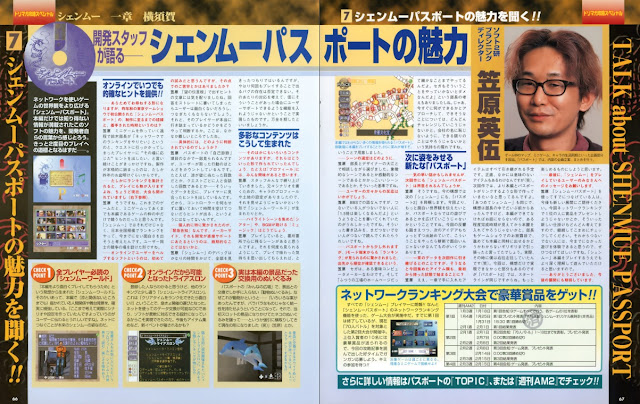
In this post we will be translating a magazine interview from shortly after Shenmue's release in February 2000 with senior Sega developer Eigo Kasahara, who oversaw the Shenmue Passport in addition to his role as Planning Director for the main game.

The translation starts below.

Eigo Kasahara was head of the Planning section for Shenmue, overseeing things like the game maps, mini-games, and characters' daily cycles. For the Passport, he was in charge of content planning and organization.

The Shenmue Passport uses the network to expand the game world. In the words of the developers themselves, you'll get a sense of the appeal of this software, which is filled with details you can't get just from playing the main game. It will surely inspire you to play the game a second time!

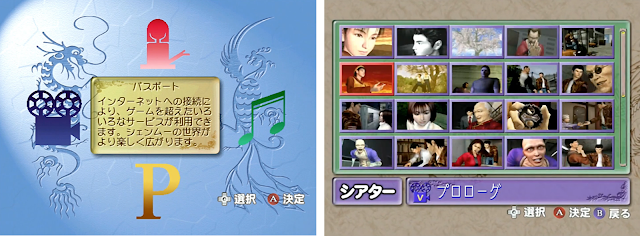
Shenmue Passport, Japanese version: entry screen (left) and Theater page (right)

Become a Patron!

Tuesday, December 7, 2021

Poll Result: Patrons' Choice Topic for December 2021

Every month Phantom River Stone holds a poll among our patrons to choose a topic for the blog in the coming month. After tallying the votes (including accumulated votes from previous months), the winning topic for December 2021 is...

"Interview with developer Eigo Kasahara about the Shenmue Passport" (translation)

When the first game in the Shenmue series was released on the Dreamcast, along with the three game discs was a fourth disc called Shenmue Passport. This was a stand-alone piece of software which acted as a companion to the main game, containing additional content to enhance the player's experience such as music, guide videos and in-depth information about the characters, places and objects in the game. It even made use of the Dreamcast's ability to connect to the internet to download data and display Shenmue related event news and other messages. (Unfortunately, the Shenmue Passport was not part of Sega's Shenmue I & II re-release in 2018, so the fan community has created an app called Suka Pass that recreates the experience for mobile devices).


In this post we will be translating a magazine interview from shortly after Shenmue's release with senior Sega developer Eigo Kasahara, who oversaw the Shenmue Passport (as well as taking on the role of planning director for the main game).


Watch for it on the blog in the near future!

Become a Patron!

Tuesday, January 29, 2019

Tough Shenmue Quiz from the Recent Fan Meeting in Yokosuka | Translation

A special Shenmue quiz was held at last month's Shenmue Fan Meeting that was held on Christmas Eve in Yokosuka. The quiz was entitled "How About Trying a Mega-Tough Quiz?" (naturally, spoken in the vein of the owner of a Lucky Hit game trying to attract customers!).

In this post we present the translated quiz questions so you can try for yourselves (answers are hidden in spoiler tags).
The quiz was devised by the MC for the event, Esra Krabbe of IGN Japan (who in fact organized the entire event together with Yokosuka City), with the promise that all the questions, while not easy, are potentially all answerable if you are familiar with through the games.

Give it a try, noting down your answers as you go. The answers follow the end of the questions, of which there are 6 in total.

Mega-Tough Shenmue Quiz from the Recent Fan Meeting in Yokosuka | Translation


Become a Patron!

Thursday, December 27, 2018

Shenmue Fan Meeting in Yokosuka: Summary & Highlights


Earlier this week, on December 24th, a group of Shenmue fans packed into a venue in Yokosuka, Japan for a Shenmue fan meeting, organized by Yokosuka City and IGN Japan.

Interest shown during the pre-registration period was so high that the originally-planned 80 places was increased by 50% to a total of 120, with attendees being selected by a draw.

The MC of the event was Esra Krabbe from IGN Japan, with on-stage guests including Masaya Matsukaze (the voice and motion-capture actor for Ryo Hazuki in the Japanese versions) as well as guests Eigo Kasahara and Hiroshi Noguchi.

Various Shenmue themed stand-up cut-outs (Ryo, Nozomi, Kurita-san, and a forklift truck) were set up at the venue. They are also part of the Shenmue Sacred Spot campaign and on other days are stationed at shops around Dobuita.

The talk show was also live-streamed to IGN Japan's YouTube channel (link to video). The chat took place in Japanese - and happily, English captions are being prepared.

In this post, we will summarize the live-stream footage from the event, with some highlights.

Become a Patron!

Thursday, November 15, 2018

Shenmue I & II Two-Hour Talk Panel with Masaya Matsukaze

Shenmue I & II Two-Hour Talk Panel with Masaya Matsukaze

The two hours of SEGA Japan's talk panel live stream discussing Shenmue I & II passed by in a flash, and did a great job of promoting its Japan release exclusively for PS4 on November 22nd. The stream included memories and comments from the guests, a quiz, and anecdotes from those who developed the original games.

Masaya Matsukaze, Ryo's voice/motion-capture actor for the Japanese version, was MC for the session and was accompanied by two of the original developers of the games: Eigo Kasahara and Hiroshi Noguchi (original roles: Planning Director and Real Time Movie Designer); they two have also been handling the localization of Shenmue I & II for the domestic market in Japan.

The guest panel consisted of members of the Japanese media, with editors/journalists from Weekly Famitsu, Dengeki Game Media, 4Gamer and IGN Japan.

A shorter stage discussion was held on the SEGA stage at the Tokyo Game Show in September with the same participants, but this time much more time was allotted.

Here is a selection of video grabs to give the flavor of the session.
Become a Patron!

Friday, November 9, 2018

Shenmue I & II Discussion Live Stream on Nov 14th (Japanese-Language)

Sega Japan will be streaming a 2-hour talk panel on Shenmue I & II on Wednesday November 14th at 8pm JST.

The MC will be Masaya Matsukaze (Ryo Hazuki's Japanese voice / mocap). Hiroshi Noguchi and Eigo Kasahara (developers on the original games & now working on the Japanese localization of I & II) will also make an appearance. The discussion will be in Japanese.

The panel guests are members of Japanese media who are self-professed fans of Shenmue, including IGN Japan, 4Gamer, Dengeki and Weekly Famitsu.

An on-stage discussion with the same participants was held at the 2018 Tokyo Game Show, but the 30-minute slot was felt to be too short, hence the longer time allowance.

YouTube live stream:

Become a Patron!

Wednesday, October 3, 2018

Shenmue at TGS 2018 | Event Visit Report

Shenmue at TGS 2018 | Event Visit Report

On Saturday, September 22nd, I joined the flood of eager game fans attending the first Public Day of the 2018 Tokyo Game Show. Information about the event in the days leading up to it indicated an exciting amount of Shenmue-related content, including a panel discussion, SEGA merchandise including a new official Shenmue T-shirt, and a hands-on play area at the SEGA booth for Shenmue I & II. Yu Suzuki himself had even made a surprise on-stage appearance during the Business Days.

Here is a report on everything Shenmue I encountered on my visit.

Getting to the Event


The day that dawned was gray and drab, with the smell of possible rain in the air. The event venue, as usual, was in Chiba prefecture at the sprawling Makuhari Messe convention center, so my alarm clock was set even earlier than Ryo's usual waking time for departing on the hour-and-a-half train journey.

Upon arrival at the convention center's train station, kitted out in my vintage Shenmue T-shirt I joined the flow of passengers heading in a single direction - no need to consult a map!

Become a Patron!